

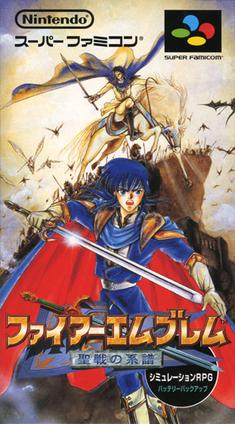
About this game
The Genre Genesis: From Modern Titans to 1995 Pioneers
Two-generation lineage romance and child unit inheritance systems (passing down weapons, holy blood, and growth rates from parents to children), massive continental-scale tactical war maps with multiple capturable castles, the canonical Weapon Triangle (Sword > Axe > Lance > Sword), and dark political-tragedy war narratives—from Fire Emblem: Three Houses, Fire Emblem Awakening, Triangle Strategy, Tactics Ogre, and Crusader Kings to modern tactical RPGs—trace their undisputed royal peak to May 14, 1996 with Intelligent Systems’ Fire Emblem: Genealogy of the Holy War (ファイアーエムブレム 聖戦の系譜, Seisen no Keifu).
Conceived, designed, and written by franchise creator Shouzou Kaga with an immortal, operatic orchestral score composed by Yuka Tsujiyoko for Nintendo on the Super Famicom (SNES), Genealogy of the Holy War holds legendary status: it was the grandest, most narratively complex, and mechanically revolutionary tactical RPG ever created on 16-bit hardware.
Platform Context & Gaming Environment: The Continent of Jugdral & The Two Generations
Genealogy of the Holy War operated on a massive 32-megabit cartridge. Set on the war-torn continent of Jugdral, the epic narrative spans two distinct generational chapters:
- Generation 1: The noble Grannvale prince Sigurd of Chalphy fights to defend his realm, falling victim to political treachery and the horrific tragedy of the Battle of Belhalla.
- Generation 2: Seventeen years later, Sigurd’s son Seliph leads the liberation army alongside the children of the first generation to overthrow the tyrannical Loptr Empire and defeat Emperor Arvis.
Popularity & Cultural Standing: The Tactical RPG Magnum Opus
Genealogy of the Holy War was an enormous critical and commercial masterpiece in Japan (selling over 500,000 copies, 31/40 from Famitsu), universally celebrated by tactical RPG historians as the greatest, most mature, and emotionally powerful storyline in Nintendo history.
Gameplay Mechanics & Technical Innovations
Genealogy of the Holy War introduced foundational strategy RPG mechanics:
- The Iconic Weapon Triangle & Magic Trinity: Established the canonical combat balance: Swords defeat Axes, Axes defeat Lances, Lances defeat Swords (and Fire > Wind > Thunder > Fire / Light & Dark)!
- Two-Generation Romance & Marriage System: Pair units in Generation 1 by fighting side-by-side to trigger marriages; children inherit their parents’ Holy Blood, stats, growth rates, personal combat skills, and legendary weapons in Generation 2!
- Colossal Continental Multi-Castle Maps: Each of the 12 massive chapters represents an entire country: seize and defend multiple castles, manage arena training, and maneuver armies across immense geographical distances!
- 12 Divine Crusader Weapons: Wield god-like holy relics (Tyrfing, Mystletainn, Balmung, Gungnir, Forseti, and Naga)!
Historical Legacy & Archival Preservation
Fire Emblem: Genealogy of the Holy War is permanently enshrined as a crown jewel of Intelligent Systems and Nintendo tactical gaming heritage.
Join the conversation