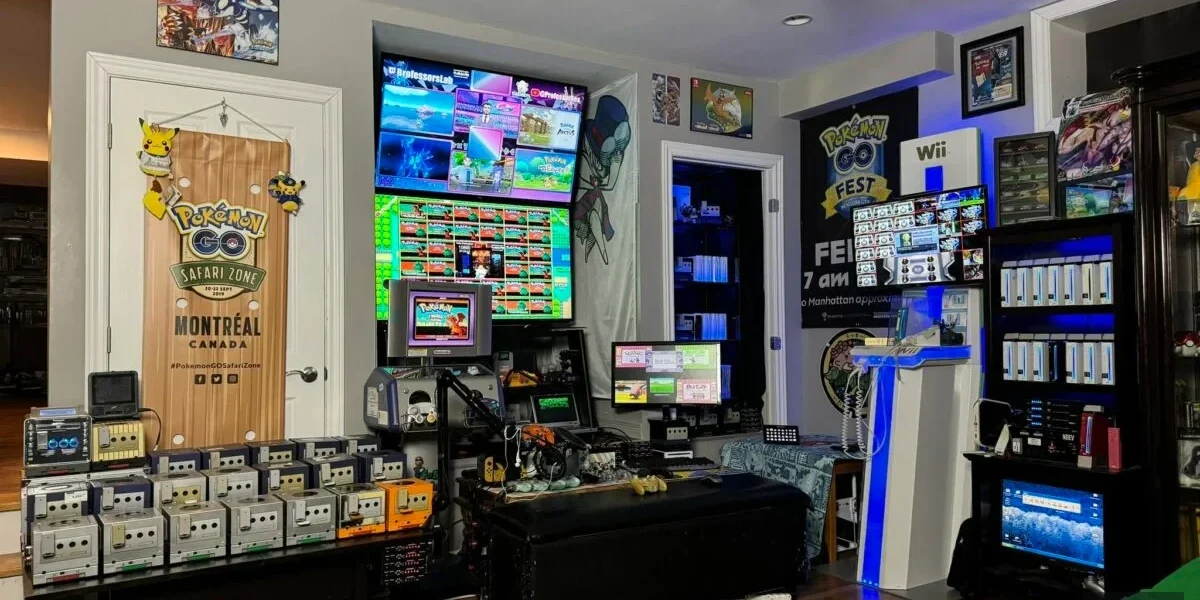
Some Pokémon enthusiasts will travel to the ends of the earth to capture their prized creature, often driven by admiration and a desire to showcase their collection. For Professor Rex, the pursuit of a Shiny Golduck across 58 consoles simultaneously was less about passion and more about mathematical probability.
He told Kotaku that he relishes uncovering and cataloguing the rarest Pokémon ever recorded, and that his fascination with statistics fuels his obsessive contemplation of what makes a Pokémon truly rare.
Pokémon conjures images of adventure and camaraderie, yet the mechanics behind encounters are governed by chance and underlying calculations. Early titles challenged players to wander through dense grass or glide across seas, hoping a random battle would present the desired Pokémon. That element of randomness has largely vanished as creatures now appear directly in the overworld, leaving the hunt for rare, alternate-coloured variants—Shinies—in legacy games as the ultimate collector’s test.
Rex, who assembled an extensive array of GameCube and Wii consoles to hunt the most elusive Pokémon, has honed his efficiency in locating these rare specimens. After setting up a system to chase a Chansey in FireRed/LeafGreen—a creature with a 1 in 806,000 chance of appearing in the Safari Zone’s random battles—he sought a new objective and expanded his rig to accommodate more consoles.
He explained that, as a self-proclaimed Safari Zone expert, he and his brother have taken part in eight ‘Safari Week’ shiny-hunting events, but once the Chansey was secured, the thrill waned. ‘I needed a target that would keep me engaged for years,’ he said.
Rex was on the hunt for a Pokémon title that would work seamlessly with his GameCube and Wii rig. Fortunately, Nintendo and Game Freak answered the call with Pokémon Box Ruby & Sapphire, a GameCube storage application that not only preserves your GBA Pokémon collection but also lets you launch the original Ruby and Sapphire on a TV. Remarkably, once the disc is inserted, you can remove it mid‑session and still finish the game, enabling the same disc to be shared across multiple systems—or even dozens of copies if you’re chasing that elusive shiny.
Why all the fuss? In the Pokémon universe, a shiny is already a rare gem, but a shiny that also appears in an unusually low‑level form is a true treasure. Take Golduck, the evolved form of Psyduck, which normally only surfaces at level 33. In certain spots, however, you can encounter a wild, under‑leveled evolution. In the Safari Zone, for instance, a level‑25 Golduck can spawn with a one‑percent base probability, and only one in sixteen of those will actually be at that rare level. Rex’s calculations suggest that a pink‑billed, level‑25 Golduck is a one‑in‑nine‑million event—making it a prime target for the most dedicated hunters.
To make headway against such odds, Rex is running the game on 58 simultaneous copies of Ruby and Sapphire, a strategy that dramatically increases his chances of snagging that coveted specimen.
How does he manage to run 58 systems at once? The answer lies in the Wavebird controller, a 2002 wireless peripheral that Nintendo released for the GameCube. Though it’s a relic by today’s standards, the Wavebird’s radio‑based communication lets multiple receivers share the same channel, sending inputs to any system they’re connected to. “Unlike modern wireless controllers, the Wavebird communicates with radio waves—so if all of the receivers are set to the same radio channel, they can all send inputs to whatever system they are plugged into,” Rex explains. “That allows for pretty‑well unlimited scaling of how many systems we can control at once.”
Professor Rex admits that, despite meticulous planning and relentless effort, his quest for the elusive Shiny Golduck remains stalled. Over the course of Safari Week 2025, he spotted eight shiny Psyducks, and in 2026 he added another six, bringing his total to fourteen shiny Psyducks that are not Golducks. Yet none of these encounters have nudged him closer to his ultimate goal, underscoring that shiny hunting is not a cumulative process—he is essentially back where he began.
At present, no shiny Golduck has appeared in his sightings, but Rex emphasizes that the chase itself is what matters most at this juncture.
“Honestly, I’m not sure I’ll ever achieve it,” Rex confides. “I chose this as the most audacious target imaginable—a shiny hunt I could pursue indefinitely.”
While the coveted level‑25 Golduck remains the ultimate prize, Rex admits that if he never stumbles upon that exact tier, a single Shiny Golduck below the level threshold would still satisfy him.
The media buzz has prompted him to consider chasing the elusive Pokémon, yet he remains realistic: any Golduck between levels 25 and 29 would do, though each encounter carries that steep 1‑in‑1.8‑million probability. He remains uncertain whether he will ever complete the quest.
❓ Frequently Asked Questions (FAQ)
Why did Professor Rex set up 58 consoles to hunt a Shiny Golduck?
Professor Rex used 58 consoles simultaneously to maximize his chances of encountering the rare Shiny Golduck by leveraging the law of large numbers—more concurrent attempts increase the overall probability of success.
How does probability play a role in shiny hunting?
Shiny Pokémon appear with a fixed, low probability per encounter (e.g., 1 in 8192 in many games). By running many consoles in parallel, the cumulative chance of seeing a shiny rises, turning a random event into a more predictable outcome.
What does this trend indicate about community-driven gaming strategies?
It highlights a shift toward hardware-intensive, collaborative approaches where players pool resources and data to influence game ecosystems, turning rare item hunting into a shared, statistically driven endeavor.
News Source: Kotaku






Comments
Be the first to comment.