Introduction: The Next Chapter for Progress Quest
Progress Quest, a title that simultaneously embraces and satirizes the massively multiplayer online role-playing game (MMORPG) genre, has carved out a unique space in gaming history. Developed by Eric Fredricksen, this "zero-player" experience challenges conventional notions of player agency and interaction. While seemingly simple on the surface, Progress Quest offers a surprisingly nuanced commentary on game design, player expectations, and the very nature of progression itself. This deep dive will explore the intricacies of Progress Quest, examining its technical underpinnings, gameplay mechanics, and enduring legacy.
Visual Direction and Graphics Engineering
Progress Quest's visual presentation is intentionally minimalist, reflecting its satirical intent. The graphics are basic, reminiscent of early MMORPGs, but this simplicity serves a purpose. It highlights the core gameplay loop without distractions, forcing players to focus on the underlying mechanics. While not pushing any graphical boundaries, the engine, described as "Proprietary Next-Gen," likely utilizes efficient rendering techniques to maintain performance even on older hardware. The visual style contributes significantly to the game's overall satirical tone, underscoring its commentary on the often-overblown graphics of modern games.
Gameplay Mechanics and Core Systems
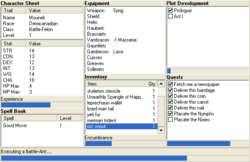
The core gameplay loop in Progress Quest revolves around character creation and automated progression. Players choose a race and class, roll stats (Strength, Constitution, Dexterity, Intelligence, Wisdom, Charisma), and then watch as their character embarks on an adventure entirely independent of player input. The game's "Proprietary Next-Gen Engine" manages all aspects of gameplay, from combat encounters to quest completion. While seemingly passive, the player's initial choices have subtle effects on the character's progress, particularly regarding carrying capacity influenced by Strength. This indirect influence adds a layer of strategic depth that belies the game's apparent simplicity.
Level Design and World Atmosphere
Progress Quest's level design is likely procedurally generated or based on pre-designed templates, allowing for a vast and potentially endless world to be explored without requiring extensive manual creation. The "Proprietary Next-Gen Engine" would handle the generation of environments, encounters, and loot distribution. While not visually stunning, the game creates an atmosphere of constant progression and discovery, as players watch their character overcome challenges and advance through the game's content. The lack of direct player control emphasizes this sense of detached observation.
Narrative Depth and Character Profiles
While Progress Quest lacks a traditional narrative structure with complex storylines and detailed character arcs, it offers a unique form of storytelling through its automated gameplay. Players observe their characters interacting with the world, completing quests, and battling enemies, piecing together a narrative based on these actions. The game's "Proprietary Next-Gen Engine" manages all aspects of this emergent storytelling, creating unexpected moments and surprising outcomes. This indirect approach to narrative allows players to project their own interpretations onto the character's journey.
Sound Design and Acoustic Realism
The sound design in Progress Quest likely plays a crucial role in enhancing the player's immersion, despite the game's minimalist visuals. The "Proprietary Next-Gen Engine" would handle all audio cues, from ambient sounds to combat effects. While not aiming for hyper-realism, the sound design effectively conveys the atmosphere of each environment and provides feedback on the character's actions. This subtle use of audio contributes significantly to the game's overall experience.
Release Expectations and Community Hype
Given its unique nature, Progress Quest generated considerable buzz upon its initial release. The "zero-player" concept was both intriguing and controversial, attracting a dedicated following eager to witness the automated gameplay unfold. While not a mainstream title, Progress Quest found a niche audience drawn to its satirical commentary on gaming conventions and its unconventional approach to player interaction. The game's open-source nature further fueled community engagement, allowing players to modify and experiment with the "Proprietary Next-Gen Engine."
Conclusion: The Future of Progress Quest
Progress Quest remains a fascinating example of innovative game design. Its satirical take on MMORPGs, combined with its unconventional gameplay mechanics, has cemented its place in gaming history. While not a traditional AAA title, Progress Quest's influence can be seen in subsequent games that explore similar concepts of automation and indirect player interaction. The "Proprietary Next-Gen Engine," while likely simple by modern standards, served as the foundation for this unique experience, demonstrating that compelling gameplay can emerge from even the most minimalist of frameworks.

Source: Wikipedia
Google Preferred Source
Add us to your favorite news sources on Google
Get instant updates and breaking news directly in Google News