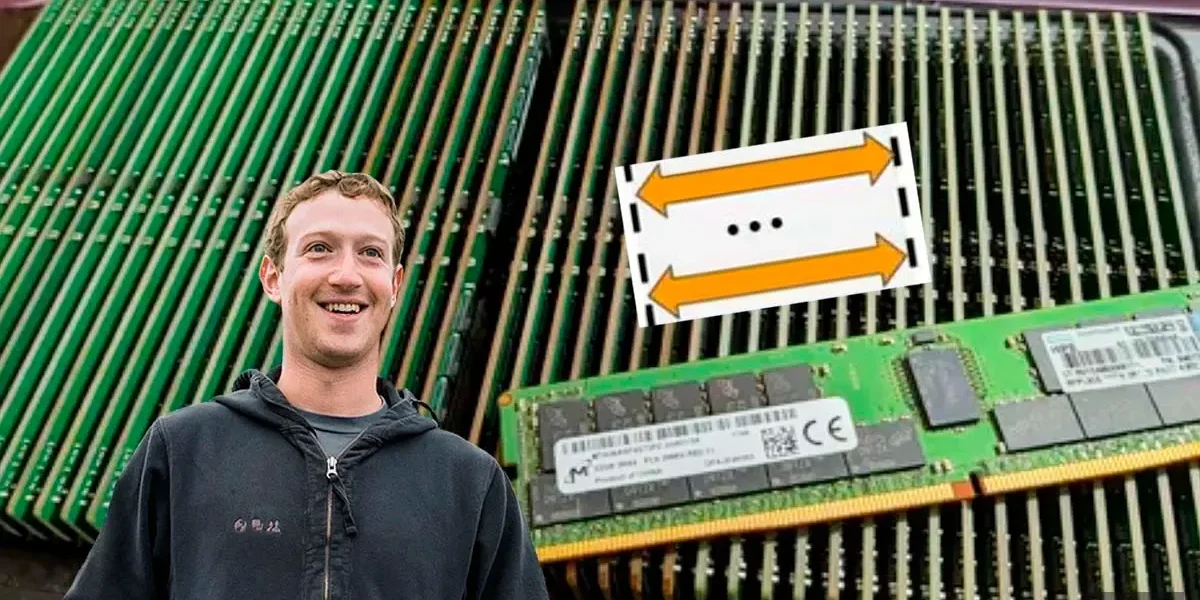
Meta has just invested millions of dollars in new servers that run exclusively on DDR5 memory, yet the company discovered that even those cutting‑edge machines were still insufficient to meet its massive daily operational demands. In response, the firm reportedly resolved the bottleneck by stripping DDR4 modules from older servers and integrating them into the latest platforms via a custom bridging chip.
This bold strategy allows Meta to fuse older DDR4 sticks with modern motherboards, creating a hybrid ecosystem that delivers a staggering 1 TB of RAM per server. The move not only sidesteps the global scarcity of high‑end components but also recycles existing technology at scale, cutting costs without compromising speed.
Conventional wisdom would suggest that mixing technologies from different eras should fail, yet Meta proves otherwise by engineering a translator that lets modern CPUs communicate seamlessly with legacy DRAM. According to PC Gamer, the key enabler is Compute Express Link, which works in tandem with Meta’s proprietary Vistara chip to manage the DDR4 reserve as an independent, autonomous memory pool.
Meta’s latest architecture diagram, revealed by PC Gamer, shows that while the secondary processing block operates at a slower pace than the main unit, the company’s sophisticated software mitigates load times by offloading non‑immediate data to a “cold storage” tier—keeping it nearby yet unobtrusive.
The report explains that all actively used data is housed in a “hot storage” layer, which is nothing more than the blazing‑fast DDR5 memory of the central processor. The system is powered by an AMD EPYC chip boasting 158 cores and a staggering 768 GB of cutting‑edge memory, a colossal amount that still falls slightly short of the corporation’s colossal demands.
To break through the performance ceiling and secure the resources required for its massive operations, Meta added an extra 256 GB of DDR4 memory via two expansion cards, achieving a total of 1 TB of memory on a single server—an amount that could effortlessly run the heaviest applications on the market.
The remarkable leap invites speculation about whether similar setups could be deployed on consumer PCs to cut costs.
PC Gamer notes that, in theory, this would be feasible if Windows supported such expansion cards.
In closing, it is clear that this technology was engineered for specialized use rather than the everyday consumer. At present, no mainstream desktop CPU can accommodate it, and the expense of acquiring all the necessary adapters would effectively erase any potential cost savings. Yet, if component prices remain sky‑high over the coming years, these corporate experiments could spark fresh strategies for cutting costs and inspire new, more affordable solutions for the broader market.
While immediate consumer uptake is unlikely, the insights gained from these trials could lay the groundwork for future breakthroughs that make advanced technologies more accessible and affordable.
❓ Frequently Asked Questions (FAQ)
Why is Meta using DDR4 memory modules in its new DDR5-only servers?
Meta is leveraging existing DDR4 sticks to address a shortage of high‑end DDR5 components while still meeting its massive daily memory demands. By integrating DDR4 into the latest platforms through a custom bridging chip, the company can scale up server memory to 1 TB per unit without waiting for new DDR5 production or incurring the high cost of a full upgrade.
How does Meta’s custom bridging chip enable DDR4 and DDR5 to work together?
The proprietary Vistara chip acts as a translator between the modern DDR5 memory controller and legacy DDR4 modules. It uses the Compute Express Link (CXL) interconnect to expose the DDR4 sticks as an independent, autonomous memory pool that the CPU can access seamlessly, effectively bridging the two generations of DRAM.
What are the performance and cost implications of this hybrid memory strategy?
Meta reports near‑native performance from the hybrid setup, with the DDR4 pool operating in parallel to DDR5. The approach cuts capital expenditure by reusing existing hardware, reduces reliance on scarce DDR5 components, and demonstrates that large‑scale cloud operators can achieve high memory density without a full hardware overhaul.
News Source: Tarreo





Comments
Be the first to comment.