The Genre Genesis: From Modern Titans to 1984 Pioneers
Isometric 3D physics-based rolling games, analog momentum navigation, and surreal M.C. Escher geometry—from Super Monkey Ball, Kula World, and Marble It Up! to modern physics platformers—were born in 1984 with Atari Games' supreme triumph Marble Madness.
Designed and programmed in 68010 assembly by 18-year-old prodigy **Mark Cerny** (who would later lead the system architecture of PlayStation 4 and PlayStation 5) with hardware engineering by **Bob Flanagan** and audio composed by **Brad Fuller** for **Atari Games**, Marble Madness was an earth-shattering technological and artistic milestone: it was the **first video game in history to utilize real-time Newtonian physics simulation on an isometric grid, and the first arcade machine to feature genuine FM synthesized stereo audio using the Yamaha YM2151 chip**.
Platform Context & Gaming Environment: The System 1 Trackball Console
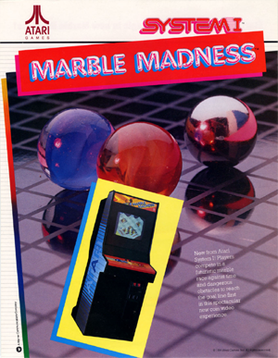
Marble Madness debuted on Atari's revolutionary **System 1 hardware platform**, powered by a 16-bit Motorola 68010 microprocessor. Housed in a futuristic upright and cocktail cabinet, the control panel featured **dual motorized optical Trak-Balls** (Blue for Player 1, Red for Player 2) with zero buttons.
The screen rendered six breathtaking, pastel-colored isometric courses inspired by M.C. Escher, accompanied by Brad Fuller's hypnotic, haunting FM synthesized musical score that synchronized dynamically with gameplay.
Popularity & Cultural Standing: The Golden Age Phenomenon
Marble Madness was an astronomical commercial and critical blockbuster across arcades worldwide throughout 1984 and 1985. Players and critics were spellbound by its silky-smooth marble momentum physics and intense 2-player competitive race dynamic.
When ported across every home console and computer (NES, Sega Genesis, Amiga, Commodore 64, Apple II, Game Boy), it sold millions of copies, establishing Mark Cerny as one of the greatest game architects in history.
Gameplay Mechanics & Technical Innovations
Marble Madness delivered mathematically sublime, kinetic physics racing:
- Real-Time Newtonian Momentum Physics: The marble accelerates down steep slopes, builds rotational momentum, and requires counter-spin friction to slow down or round narrow corners.
- Six Iconic Isometric Courses:
- Practice Race: A gentle introduction to slope physics.
- Beginner Race: Weave around narrow drops and ramps.
- Intermediate Race: Avoid Marble Munchers and acid pools.
- Aerial Race: Soar across catapult ramps and floating girders.
- Silly Race: An inverted-physics world with upward-climbing ramps.
- Ultimate Race: The grueling, razor-thin final gauntlet.
- Surreal Hazard Denizens: Evade the predatory green Marble Munchers, puddles of melting acid, black enemy marbles, and crushing floor pistons.
- Accumulative Time Bonus: Unused seconds from completed races carry over to subsequent stages, rewarding flawless speedruns.
Historical Legacy & Archival Preservation
Marble Madness is permanently inducted into the World Video Game Hall of Fame and the Smithsonian Institution. As Mark Cerny's crowning arcade masterpiece, its influence on physics-based video game design is immortal.