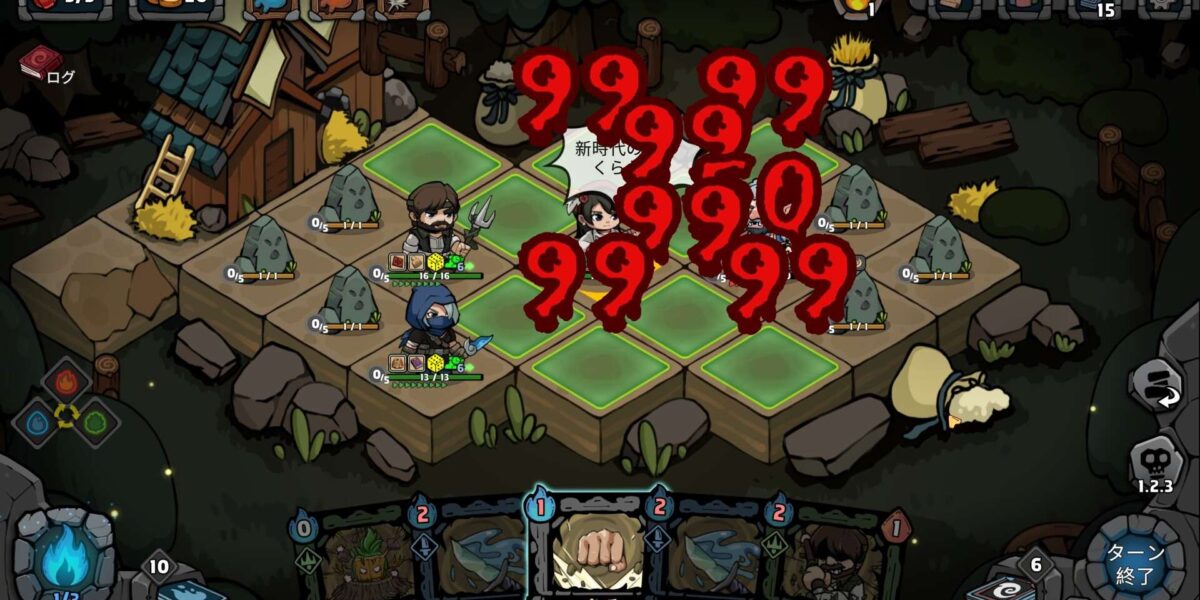
In just six minutes, this article delivers a concise yet comprehensive overview of the latest free demo from publisher Harrison World, featuring Seahorse Games’ latest title, Re:Night – Endless Night (hereafter Re:Night). The demo is currently available on PC via Steam, and it supports Japanese text, making it accessible to a broad audience.
Re:Night is a deck‑building, turn‑based strategy game that plunges players into a village swallowed by a night of supernatural chaos. Players choose from three distinct characters and must break the endless cycle of night by engaging in tactical battles that resemble classic SRPGs, but with a unique twist: every action is dictated by a randomly drawn card from a deck. This mechanic forces players to consider not only the order of their hand but also unit positioning and turn sequencing, creating a deep layer of strategic depth.
During the Steam Next Fest 2025 October edition, Re:Night topped the card‑game genre’s demo rankings, cementing its status as a standout title in a crowded market.
The battle system diverges sharply from conventional strategy games. The tutorial intertwines system mechanics with narrative, encouraging players to engage from the outset. Each character has a fixed movement range, allowing multiple moves per turn. The team collectively starts with three energy points, which are spent to play cards that attack enemies within range. For example, a player might move one square, attack three times, then shift another square—all within a single turn. If a player chooses not to expend all movement or energy, the turn ends and the enemy takes its action, creating a continuous back‑and‑forth rhythm that demands careful planning.
What truly sets Re:Night apart is its elemental triad system—water, fire, and grass—combined with a layered affliction mechanic. Most attack cards carry an elemental tag, inflicting damage and applying a weakness that doubles subsequent damage. The game allows up to five layers of affliction, meaning a single attack can potentially deal up to six times the base damage. While most cards deal around two points of damage, buffs and elemental combos can unleash dozens of points in a single strike, delivering a satisfying burst of power that rewards strategic synergy.
Even when a weakness is exposed, many attack cards overwrite it with a different element. Each character specializes in a unique attribute, and most attack cards are exclusive to that character. Because the hand each turn is shuffled at random, you must constantly decide who to move first, which order to play, whether to apply a critical element this turn or set up for the next, and how to counter the enemy’s own elemental assaults. With the enemy’s next move visible, you can surround a weakened ally with teammates, creating a chess‑like strategy that feels both satisfying and cerebral. Status effects such as sleep add further depth, forcing you to sometimes sacrifice an ally to revive them later.
In terms of overall progression, the game begins by selecting three out of six distinct roles—attacker, tank, and shooter—each with its own roster of dedicated cards. This variety yields over twenty different build archetypes, and the player then advances through a branching map one tile at a time, reminiscent of Slay the Spire. Defeating the boss at the end of each map unlocks the next, with the goal of clearing all three maps. Along the way, you’ll encounter combat, shops, random events, and tiles that allow you to upgrade or discard cards. With more than 300 cards to choose from and over 100 pieces of equipment—up to four per character—you can craft a truly unique setup each run.
For example, the author focused on a water‑affinity attacker named the Thief. This character’s deck grew to include several zero‑cost energy‑replenishing cards and a card that restores one energy when you’re out of it. By equipping an item that grants an extra energy at the start of each turn and adding draw‑boosting gear to other characters, the author constructed a rapid‑fire build that could launch five or more attacks per turn. Applying water in a single burst and exploiting the enemy’s grass weakness for massive damage felt incredibly rewarding.
Another hallmark of the title is its accessibility. Players can rewind any turn, the start of a turn, or even the entire battle, allowing them to experiment without fear of failure. After combat, all characters heal fully, and a fallen hero can be resurrected by spending a revival stone. Although revival stones are limited mid‑map, defeating a boss replenishes them entirely, encouraging bold tactics during boss fights. Hovering over a card reveals its effects, and right‑clicking shows the upgraded version, making it easy to test builds without frustration. These thoughtful features keep players engaged through long nights of replayability.
News Source: Automaton-media





Comments
Be the first to comment.