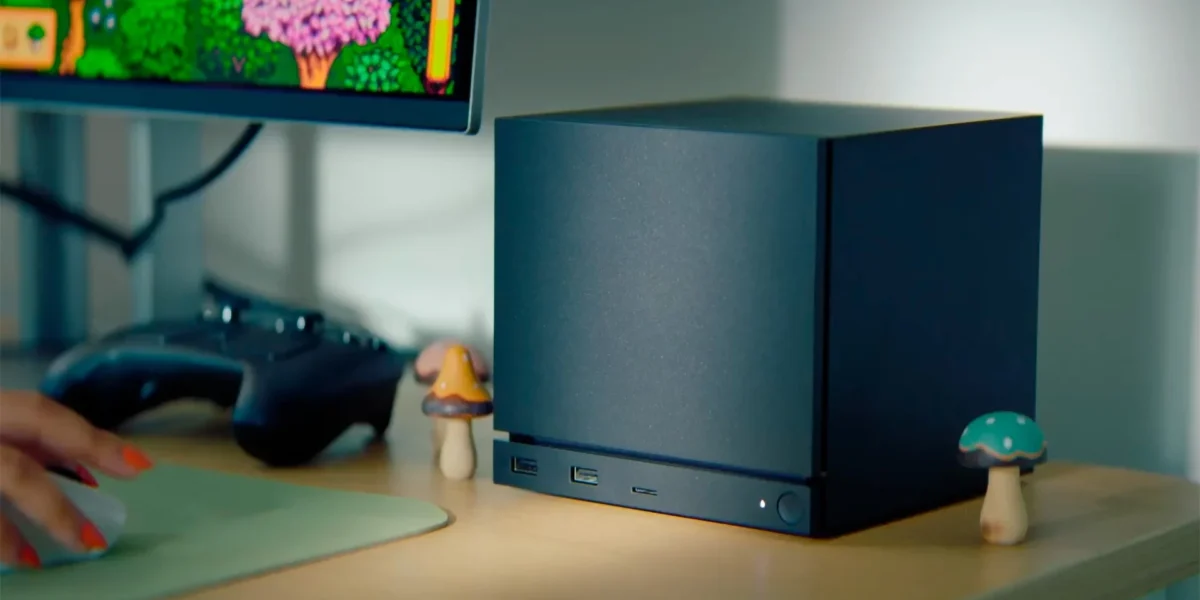
Valve’s Steam Machine has finally arrived. Prospective buyers can now join a waiting list for the inaugural shipments, while reviewers have already taken the device for a spin. Though the price tag is steep, opinions are split: some praise its innovative design, while others question whether the performance justifies the cost.
IGN’s Jacqueline Thomas praised it as “the best living‑room PC I’ve ever used, even though it lags slightly behind the flagship consoles.”
PC Gamer’s Andy Edser offered a more skeptical view. He wrote, “As a hardware reviewer, the first question you must ask is: would I purchase this?” He added that despite the sleek black box, superb controller, and inherent curiosity factor, the verdict is a firm no.
The real challenge lies in frame rates. For gamers who demand 60fps with ray‑tracing enabled, the Steam Machine may fall short. Reviewers struggled to hit 60fps in recent titles, even on medium settings without ray‑tracing. Valve promised that the console would deliver many Steam games at 60fps in 4K, aided by frame‑generation technology, but blockbuster titles such as last month’s 007 First Light may still lag behind console‑optimized versions in consistency and smoothness.
On medium presets, IGN reported that Cyberpunk 2077 and Forza Horizon 6 hovered near 60fps, while Death Stranding 2 averaged about 45fps and 007 First Light trailed just under 60fps. The outlet noted that this isn’t the same locked 60fps that the PS5 or Xbox Series X achieve, largely because those consoles employ dynamic resolution to keep frame rates steady.
Steam’s latest console, the Steam Machine, faces a fundamental dilemma: it carries a PC price tag yet promises console‑level performance only when each title is specifically optimized for it. Digital Foundry’s Richard Leadbetter notes that the system delivers “ballpark entry‑level performance for a mainstream PC capable of running the latest titles at decent resolutions.” In other words, 1440p is achievable, but achieving a smooth experience hinges on careful settings adjustments and title‑specific tuning.
Linus Tech Tips offered a more skeptical view. “There is no path that I can trace that will lead to acceptable performance on this hardware, especially in light of Valve’s unqualified claims of 4K 60fps, which still wouldn’t be a huge problem if it wasn’t for the big white elephant, the PlayStation 5,” Linus Sebastian said. “On paper, the Steam Machine and the PS5 trade blows, but in real life, I’m sorry, Valve, but it just doesn’t quite seem to work out that way.”
One frustrating issue that has emerged is the machine’s unreliable sleep functionality. The reviewer reports that after leaving a game running and putting the system to sleep, the game sometimes resumes exactly where it was after 12 to 14 hours, while other times the session disappears entirely, and on one occasion the TV turned on by itself during the night. Valve’s Steam Deck has already addressed these concerns, so there is hope that the Steam Machine will follow suit in future updates.
After nearly two weeks of hands‑on testing, Valve’s Steam Machine proves to be a compact, whisper‑quiet PC that feels more like a piece of modern art than a conventional gaming rig. Built on standard AMD components, its performance sits squarely in the same range as the Xbox Series X or PlayStation 5, yet its dimensions are comparable to a taller Nintendo GameCube—small enough to fit in a living‑room corner yet powerful enough to run modern titles without compromise.
Priced at $1,049 for the base model and $1,349 for the 2 TB version, the Steam Machine may seem steep for casual buyers. However, for those who have been deterred by the hassle of driver installs and overclocking, it offers a plug‑and‑play alternative that turns any TV into a gaming console. In essence, Valve’s vision of a ready‑to‑play PC for the living room is finally materialising.
Valve’s ambition to bring PC gaming into the living room is commendable, yet the ongoing memory shortage has pushed the cost of components higher, leaving the Steam Machine on the pricier side. With a modest GPU and a handful of software hiccups, it feels more like a boutique collectible than a mass‑market gaming platform.
While the Steam Machine outshines a typical desktop in aesthetics, silence, and space efficiency, its upgrade path is severely limited. Only RAM and storage can be swapped, leaving the system effectively locked in its initial configuration—an important consideration for gamers who value future‑proofing.
The Steam Machine may not have landed at the price point its creators envisioned, yet its core concept has come to fruition—an idea I wholeheartedly endorse. It stands as a genuine platform, a foundational layer upon which developers can build. Much like the Steam Deck, it offers a solid target for game creators, a reliable optimization baseline that accommodates almost every indie title and a large swath of major releases. Uniquely, it treats players as competent adults rather than children, and I am confident it will only grow stronger over time. As Valve’s original blueprint for the Steam Machine and the reality of the Steam Deck demonstrate, it serves as a template that other manufacturers could readily adopt to craft even more powerful products, all while running an operating system that is, in every sense, free.
❓ Frequently Asked Questions (FAQ)
What is the main criticism of the Steam Machine's performance compared to flagship consoles?
Reviewers have noted that while the Steam Machine offers a sleek design and console-like experience, it struggles to consistently hit 60fps in recent titles, especially with ray‑tracing enabled. Even on medium settings without ray‑tracing, many games fail to reach the 60fps mark, making it less competitive for gamers who demand high frame rates.
How does Valve plan to address frame rate concerns in the Steam Machine?
Valve has promised that the console will deliver many Steam games at 60fps in 4K, aided by frame‑generation technology. This technology aims to upscale lower frame rates to smoother gameplay, potentially mitigating the performance gap with flagship consoles.
Is the Steam Machine considered a good value for its price?
Opinions are split. Some reviewers praise its innovative design and console‑like experience, while others, like PC Gamer’s Andy Edser, argue that the steep price tag is not justified by its performance. The verdict varies depending on whether a buyer prioritizes design and convenience over raw gaming performance.
News Source: Kotaku






Comments
Be the first to comment.