I’ve been a Windows user since the early 2000s, when I was just a pre‑teen exploring the limited worlds of Windows 98 and Windows 2000 on school computers. The real home machine, however, was a Windows XP system that became my primary hub for everything from school assignments to gaming.
While I spent most of my time crafting Word and PowerPoint presentations for school, the PC was also my gateway to entertainment. My father would bring in game discs, and we’d spend hours installing them—sometimes successfully, sometimes not. When the discs failed, we’d turn to browser‑based flash titles like Bubble Trouble on Miniclip.
Unfortunately, the dial‑up connection that powered those flash games was a major bottleneck. On a lucky day, the line might reach 56 kbps, but more often it hovered around 33 kbps, turning even the simplest online game into a marathon of loading screens. Downloading pirated titles was equally frustrating, and the Big Fish Games simulator downloads I tried were merely trial versions that required a purchase for full access.
All of this made it difficult to find reliable entertainment on my home PC, a challenge that ultimately led me to an unlikely companion: Microsoft Paint.
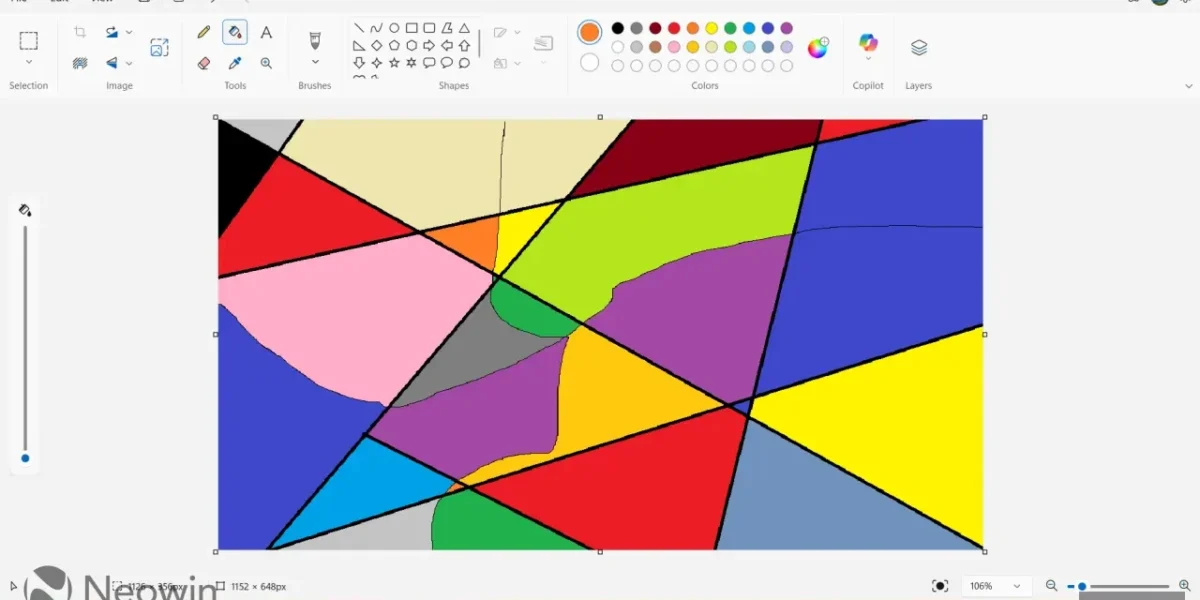
Whenever my internet connection faltered, I’d launch Microsoft Paint and let the frustration melt into a stream of spontaneous sketches. It wasn’t a deliberate art project, but the inevitable result of a botched straight line or a misfired brushstroke—so I’d abandon the piece and unleash a chaotic collage of shapes and colors.
My own digital doodles were far from polished; I favored a style of haphazard intersecting lines splashed with random hues, a throwback to the abstract flair of Picasso. In the newest iteration of Paint, I’ve tried to capture that same spontaneous spirit, and the results echo a playful, almost cubist aesthetic.
Fast‑forward to today, and the picture remains largely unchanged. Now that I’m almost 29, I still have no professional need for Microsoft Paint, and I rarely use it in my personal life—just enough to confirm that its core functions are still intact. I’m pleased to report that Paint still delivers the same accessible, user‑friendly experience that first drew me in, even after its interface has been refreshed and Copilot features have been woven in.
Things could have taken a very different turn if Microsoft had followed through on its original plan. During the Windows 10 Fall Creators Update in 2017, Paint was slated for retirement and a notification even appeared, urging users to migrate to Paint 3D. Public outcry forced Microsoft to reverse that decision, keeping Paint as a native Windows app that continues to receive updates via the Microsoft Store. Paint 3D, on the other hand, was quietly shelved—an outcome I think ultimately benefited the broader user base.
I’ve sampled the updated Paint experience over the past few years and find the enhancements worthwhile. The user interface has been modernized, the overall experience feels fresh, yet the core functionality remains unchanged, keeping the app approachable and straightforward. While it still doesn’t satisfy any of my specific use cases, I’ve never had many that require a more sophisticated tool.
Microsoft’s decision to retain Paint as a built‑in application in Windows 11 is a quiet nod to the past that also serves the present. The venerable program, once a staple of early Windows experiences, has been quietly modernized to meet today’s creative demands while preserving its classic charm. Though it may no longer be a daily tool for many, its continued presence underscores Microsoft’s commitment to legacy and user familiarity.
❓ Frequently Asked Questions (FAQ)
Why did Microsoft Paint remain a favorite app for many Windows users, even after newer graphics programs appeared?
Microsoft Paint stayed popular because it was simple, lightweight, and shipped with every Windows installation. For users who were just learning to use a computer—especially kids in the early 2000s—it offered an easy way to experiment with drawing, color, and basic image editing without the complexity of professional software. Its familiarity and zero cost made it a go‑to tool for quick sketches, school projects, and even simple game art, keeping it relevant long after more advanced programs entered the market.
How did dial‑up internet speeds affect early 2000s gaming experiences?
Dial‑up connections, typically 33 kbps and occasionally 56 kbps, made online gaming a slow, frustrating experience. Even simple flash titles would take minutes to load, and multiplayer sessions were plagued by lag and long waiting times. This bottleneck pushed gamers toward local or cartridge‑based titles and made developers focus on downloadable content and subscription models once broadband became widespread, reshaping the industry's revenue streams.
What lessons can modern game developers learn from the challenges of early 2000s online gaming?
Modern developers can see the importance of optimizing for varying bandwidths and ensuring that games remain playable on lower‑end connections. The early 2000s demonstrated that limited internet speeds could stifle multiplayer growth, so designing scalable, bandwidth‑efficient networking code and providing offline or local play options can broaden a game's audience and improve user experience even when connectivity is spotty.
News Source: Neowin





Comments
Be the first to comment.