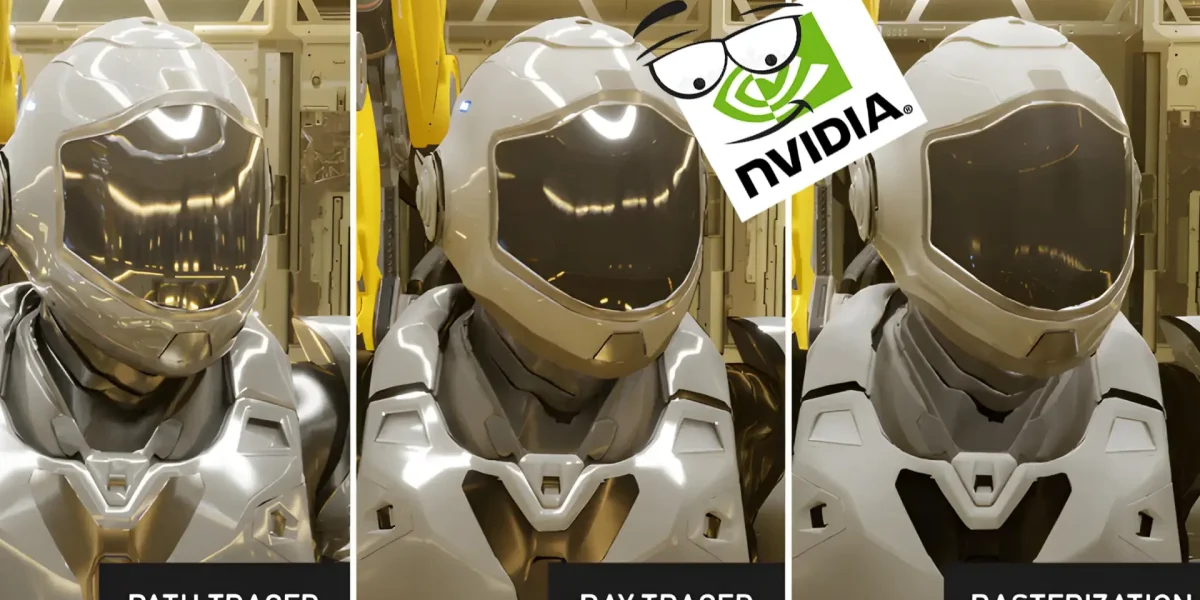
The relentless pursuit of ever more lifelike visuals has historically pushed computer performance to its limits, but NVIDIA is on the brink of a seismic industry breakthrough with a new software initiative.
At the heart of this effort is a proprietary algorithm the company calls NVIDIA ReSTIR PT Enhanced, a tool specifically engineered to deliver breathtaking graphics without sacrificing system fluidity.
To understand why this matters, it helps to know that Path Tracing—a technique that meticulously simulates how light bounces in the real world to create perfect shadows and reflections—quickly drains even the most powerful modern GPUs.
Its standout feature is a dramatic FPS boost achieved at native monitor resolution, cutting reliance on upscalers that stretch smaller images to appear larger and conserve resources.
To illustrate the real‑world impact of the new algorithm, NVIDIA’s developers benchmarked it against the notoriously demanding title Cyberpunk 2077. The results are striking: instead of struggling to hit 33 FPS on native 4K, the technology can lift performance to a smooth 60–70 FPS range. Coupled with DLSS 4.5, it delivers superior image stability and balanced modes that surpass the visual quality of the highest settings from previous generations.
Such aggressive software optimizations could dramatically influence the viability and success of NVIDIA’s forthcoming RTX 50 series. Amid rumors that the next RTX 60 lineup will offer only a modest 30 % boost in rasterization performance, the company is betting heavily on these intelligent algorithms. Classic rendering is gradually being supplanted by realistic light simulation, and NVIDIA is leveraging this technological leap to extend the life of its Blackwell architecture while phasing out older world‑building techniques.
Ultimately, the research documents reveal that NVIDIA ReSTIR PT Enhanced is not only faster but also markedly reduces visual artifacts that mar the screen. By unifying direct and global illumination within a single process, it eliminates annoying visual noise. With this innovation, NVIDIA aims to perfect the system for full stability and market readiness, demonstrating that the industry’s future hinges less on raw hardware horsepower and more on smart solutions that transform our interaction with technology.
❓ Frequently Asked Questions (FAQ)
What is NVIDIA ReSTIR PT Enhanced and how does it improve real-time ray tracing performance?
NVIDIA ReSTIR PT Enhanced is a proprietary algorithm that optimizes path tracing—a technique that simulates realistic light bouncing—to deliver high-fidelity graphics at native resolution without draining GPU resources. By intelligently reusing sample data across frames, it reduces the computational cost of path tracing, enabling smooth 60–70 FPS in demanding titles like Cyberpunk 2077 at 4K, where earlier it struggled to hit 33 FPS.
Does ReSTIR eliminate the need for upscaling technologies such as DLSS?
ReSTIR significantly reduces reliance on upscalers because it boosts frame rates at native resolution. While it can still be paired with DLSS 4.5 for additional image stability and balanced modes, the technology itself allows games to run smoothly without stretching lower-resolution images to fit higher displays, thereby conserving GPU resources.
What impact could ReSTIR have on gamers and GPU vendors?
By delivering lifelike ray tracing at native resolution without costly hardware upgrades, ReSTIR could accelerate mainstream adoption of real-time ray tracing, lower the barrier for gamers to experience high-quality visuals, and shift the competitive landscape among GPU vendors—potentially making high-end GPUs less essential for cutting-edge graphics.
News Source: Tarreo






Comments
Be the first to comment.