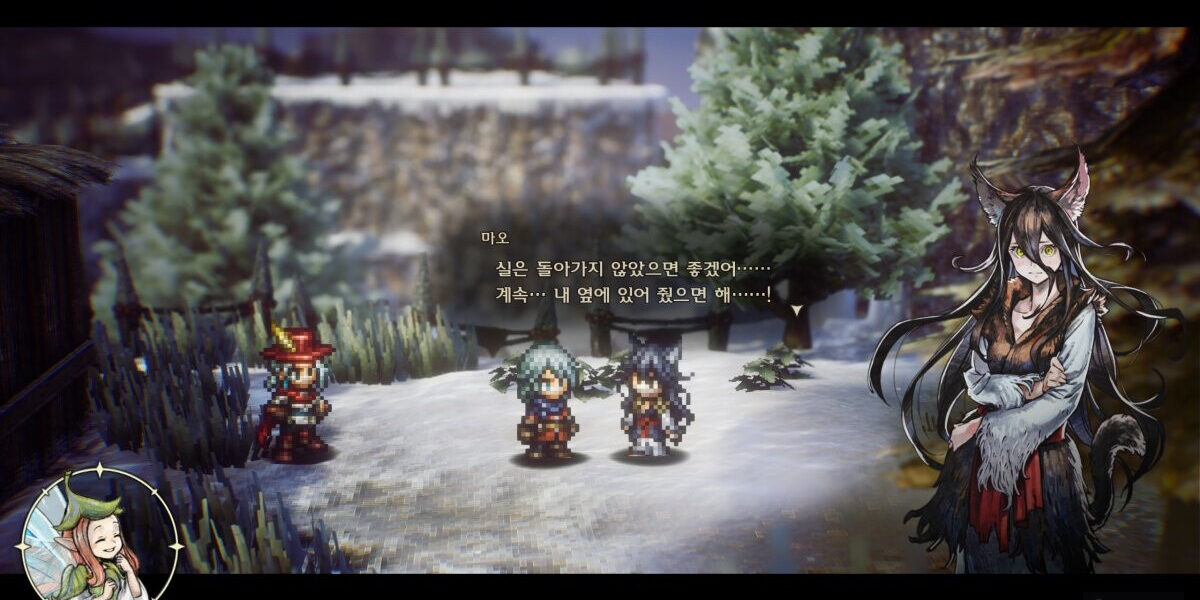
Square Enix’s HD‑2D was once hailed as a visual breakthrough, marrying modern rendering techniques with the nostalgic charm of pixel art to deliver a timeless, classic aesthetic that still feels fresh today.
Although the HD‑2D label is a Square Enix trademark, similar stylistic approaches have emerged elsewhere, and imitators abound. Yet the texture and depth that HD‑2D imparts go beyond simple pixel art, offering a sensory richness that pure 2D titles cannot match.
Because of this unique visual language, HD‑2D has been employed in original IPs such as Octopath Traveler and Triangle Strategy, and later in remakes of Square Enix classics like Live A Live and Dragon Quest. All of these games foreground a classic feel, reimagined within the RPG genre.
Consequently, much of the anticipation for Adventurer Elliott’s Thousand‑Year Tale centered on its HD‑2D action. The demo showcased a homage to classic action RPGs reminiscent of Zelda and the Sword of the Legend series, and the full game delivers on that promise.
Beyond visual flair, HD‑2D also plays a pivotal role in level design. In turn‑based RPGs, background effects and depth cues add little to actual gameplay, but in action titles they become integral to map layout and environmental puzzles.
The game’s protagonist, Elliott, moves freely across a 2D plane that feels three‑dimensional thanks to HD‑2D’s depth cues. The camera often tilts to capture a low, ground‑level view, while the background world itself is rendered in 3D to enhance spatial perception.
These height variations are not merely visual tricks; they influence real‑time movement, combat, and puzzle solving. Players must decide when and where to step on moving platforms, how to attack enemies at different elevations, and how to navigate complex pathways that shift dynamically.
Height differences are exploited from simple gimmicks to intricate puzzles, echoing the design philosophies of Zelda’s Triforce and the Sword of the Legend series. Yet HD‑2D’s contribution lies in fundamentally altering level design rather than merely satisfying visual nostalgia.
Elliott’s journey begins in the tranquil Huder Kingdom, a world that feels open yet not overwhelmingly vast. Instead of a segmented hub, the game offers a single, explorable open field where diverse biomes—lush grasslands, marshes, deserts, snowy peaks, and volcanic zones—interact seamlessly.
Each biome hosts uniquely themed dungeons that incorporate local aesthetics and mechanics, creating a varied combat experience that remains grounded in classic action RPG principles.
Combat is intentionally straightforward: there is no separate dodge mechanic, so players must block and attack strategically. The guard meter depletes with each block, forcing active movement to avoid damage, while powerful finishing moves can be unleashed with a simple charge button.
As the story progresses, new weapons—spears, hammers, chainsaws, bows, boomerangs, and bombs—are unlocked, each offering distinct playstyles. The introduction of shields also enables parrying, adding a layer of tactical depth.
Weapon variety is further enriched by “magic stones,” which can be equipped to modify damage, critical chance, or even alter a weapon’s fundamental behavior. For example, a bomb might emit a flame field before detonating, or a chainsaw could fire fireballs during a charge.
Unlike traditional RPGs, the game lacks a conventional level‑up system. Instead, progression hinges on exploration: discovering higher‑grade magic stones, acquiring new weapons, and increasing health through fragments found in dungeons and shrines.
Exploration drives growth, but the pacing can feel rushed. While weapons and items unlock new paths—such as using a hammer to break a giant nail or a bomb to clear debris—these moments are limited to specific acquisition points, and the overall dungeon layout often reuses familiar mechanics.
Despite the absence of a true metroidvania structure, the game incorporates puzzle elements that serve the narrative, such as light‑based riddles or water‑manipulation challenges. These puzzles, while integral to story progression, feel more like linear checkpoints than exploratory gameplay.
Consequently, the game’s pacing can become monotonous in later stages, as the variety of weapons and builds dwindles and the player tends to stick with a single favored tool.
Nonetheless, the overarching narrative keeps players engaged. Elliott is not a typical heroic figure; he is a compassionate adventurer who values helping others, a trait that resonates throughout the story.
His travels span multiple eras—each with distinct cultures and challenges—allowing him to influence events across time. However, the ripple effects of his actions are subtle, often manifesting as minor character changes rather than sweeping world transformations.
These narrative choices create a classic, almost fairy‑tale structure: a hero’s journey that unfolds gradually, with a deceptive “fake” ending that leads into deeper revelations about the world and its inhabitants.
The game’s visual style, anchored by HD‑2D and the evocative illustrations of Naoki Ikushima, reinforces its lyrical tone. Character portraits, complete with expressive mouth movements, add emotional depth and help players connect with the story.
As the plot accelerates, the limited number of interactable towns and characters keeps the cast tight, yet the interwoven relationships across eras maintain a compelling sense of continuity.
While the ending may initially feel a bit forced, once players recognize that the foreshadowing introduced early in the game threads seamlessly into the climax, the conclusion feels more satisfying than disappointing. This is achieved by keeping the story within a time‑travel framework and stripping away the clutter of multiverse or paradox tropes, allowing the narrative to focus only on the essential beats. The fairy Phe, who expands the game’s action and puzzle mechanics with magic, also plays a pivotal role in the story. ©INVEN
The presence of Phe shifts the game’s tone, offering tools and spells—such as acceleration, teleportation, and ignition—that help players navigate boss encounters and puzzles while filling gaps in the action. When a player’s character dies, they can revive using a tool, though the cost rises each time, adding a strategic layer to resource management. Narratively, Phe breathes life into Elliott’s solitary journey, appearing at the screen’s bottom to chat incessantly, breaking the game’s silence and guiding the player toward new paths. Like many characters in the title, Phe is devoid of malice yet charmingly writes her own story, allowing her to blend smoothly into the game world.
In this honest character portrayal and clear foreshadowing, each era transition deepens immersion. However, the gameplay itself offers less satisfaction compared to the story. The terrain remains largely shared, diminishing the sense of exploring new areas; it feels more like revisiting the same region with a slightly different layout. The narrative compensates for this shortfall, providing the missing emotional payoff.
Elliott’s thousand‑year adventure is packed with diverse, appealing elements—battles reminiscent of the Sword‑and‑Spear legend, exploration and growth structures echoing Zelda, and a classic JRPG‑style hero’s journey. While the fun moments become somewhat disjointed, the early variety in combat and exploration keeps players engaged, and the later narrative’s regained momentum enhances immersion. The game stitches these disparate segments together with HD‑2D visuals, emotive illustrations, and lyrical music that permeate every scene. When the final ending concludes, the game’s New Game+ feature invites players to revisit the world, reflecting on the extensive foreshadowing woven throughout the experience. ©INVEN
❓ Frequently Asked Questions (FAQ)
What is HD-2D and how does it differ from traditional pixel art?
HD-2D is a visual technique pioneered by Square Enix that blends modern rendering methods—such as dynamic lighting, shading, and depth cues—with classic pixel art. Unlike pure 2D pixel art, which is flat and static, HD-2D adds texture, depth, and a sense of dimensionality, giving games a nostalgic feel that still feels fresh and visually rich.
How does Adventurer Elliot use HD-2D to enhance its action gameplay?
Adventurer Elliot extends HD-2D beyond aesthetics into core gameplay. The depth cues and background effects become integral to level design, helping players navigate maps, spot enemies, and plan tactics. This transforms the classic RPG look into a dynamic action experience that balances nostalgia with modern design.
Which other games have employed HD-2D besides Adventurer Elliot?
Square Enix has used HD-2D in several titles, including original IPs like Octopath Traveler and Triangle Strategy, as well as remakes of classics such as Live A Live and Dragon Quest. These games showcase how the style can be adapted across different RPG sub‑genres while maintaining a timeless aesthetic.
News Source: Co



Comments
Be the first to comment.