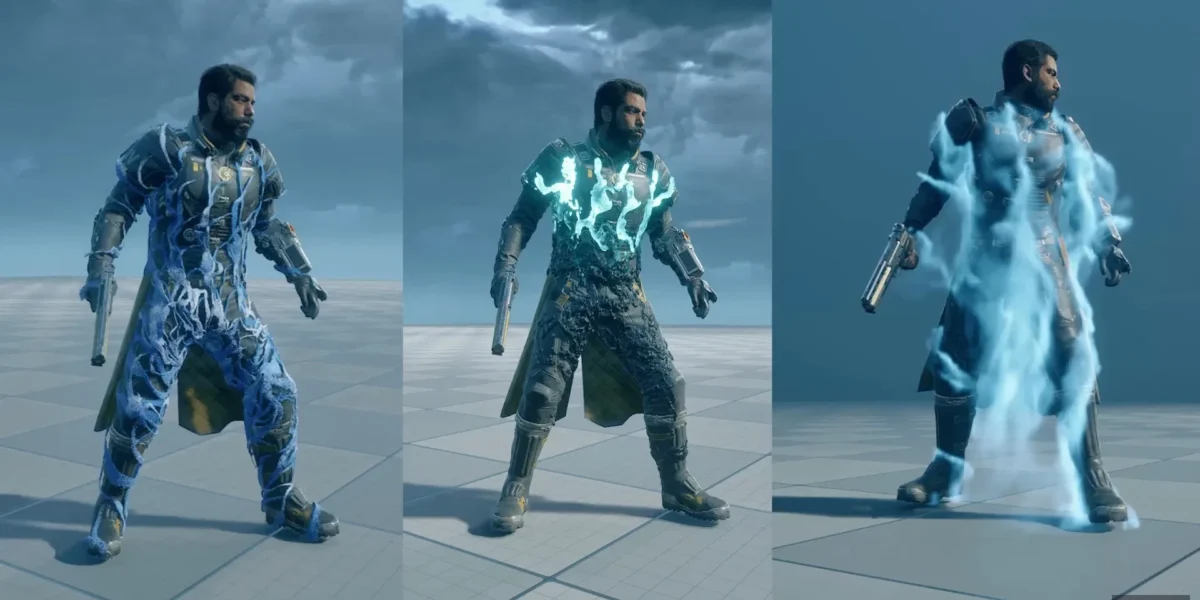
Five years ago, we explored how Returnal’s visual effects were brought to life, spotlighting the real‑time voxeliser that turned Phrike into swirling volumetric mist. If you haven’t yet seen that piece, it’s a perfect companion to this update.
With the launch of Saros, we didn’t merely iterate on the technology that powered Returnal. Instead, we took a step back, examined three decades of engine evolution, and re‑engineered it into a single, cohesive framework: Graphite.
Our in‑house particle system, NGP (Next‑Gen Particles), began as a proof‑of‑concept for Resogun in 2013 and has evolved with each project, culminating in its refinement for Returnal. By the time Saros arrived, NGP had reached maturity, yet it was still the product of twelve years of piecemeal choices, each tailored to a specific, isolated title.
Then a pivotal shift occurred: we joined PlayStation Studios. This transition demanded that we deliver experiences that meet the high standards our players anticipate, and it also meant that our tools—and the names we’d given them—no longer aligned with the studio identity we were shaping.
Introducing Graphite, a unified architecture that fuses GPU simulation, rendering, tooling, and DCC integration—all engineered specifically for PlayStation hardware. The legacy of NGP lives on, now embedded within Graphite, where it has been refined and expanded to deliver unprecedented performance and flexibility.
Every Housemarque title boasts a distinct visual language that players instantly recognize, and Graphite is the engine behind that unmistakable identity.
To truly grasp what Graphite accomplishes on a frame‑by‑frame basis, we turn to the brilliant minds who built it: Graphics Architect Sharman Jagadeesan and Senior Graphics Programmer Konsta Toivanen.
They will guide us through the evolution of volumetric fog in Saros, tracing its roots back to Returnal, and reveal the two custom systems that breathe life into Carcosa’s atmospheric world.
VFX Architect Risto Jankkila will walk us through how the team expanded Graphite by integrating data sourced from Houdini, providing a detailed breakdown of the player spawn sequence that showcases the new procedural workflow.
Fog is often treated as a cosmetic afterthought, simply filling empty space and masking rendering limits. In Saros, the team reimagined fog as a living, responsive component that reacts to every event within the game world.
Returnal’s volumetric fog was already reactive, but its low update frequency and heavy temporal filtering obscured fine detail. For Saros, the developers engineered a dual‑layer system: a low‑frequency fog layer that establishes atmospheric ambience, and a high‑frequency layer that delivers crisp character‑centric effects in the story‑rich rooms of Carcosa.
Building on Unreal Engine’s froxel fog—a frustum‑aligned voxel grid—the team overhauled key components to align with their creative vision, ensuring the fog system meets the demanding performance and visual goals of Saros.
Achieving temporal stability was the first hurdle. The fog’s hysteresis coefficient determines how much of the previous frame’s data is retained; Unreal Engine’s default of 90 % keeps the image steady but can make fog appear sluggish when cameras or lights move quickly. We lowered this figure to 50 %, supplementing the change with blue‑noise jitter and depth clamping to suppress any resulting aliasing.
Saros demanded a fog system capable of spanning the spectrum from delicate ambient mist to thick, ground‑level haze. To meet this requirement, we integrated a suite of volumetric rendering techniques that faithfully reproduce both subtle and dense fog conditions.
The low‑frequency component of the fog is fully interactive. Our player‑tracking fluid simulation feeds directly into the density hysteresis step, ensuring that every movement, projectile, explosion, and enemy interaction is instantly reflected within the fog in real time.
For the high‑frequency layer, we engineered a custom ray‑marcher. To balance performance with visual fidelity, we first cluster scatter data into 8 × 8 × 8 voxel blocks, rendering only those clusters that contain data. A user‑defined threshold limits the number of active clusters, while empty regions between clusters are skipped, allowing the marcher to take larger steps where possible.
❓ Frequently Asked Questions (FAQ)
Where can I find more details about Unveiling Saros's VFX: NGP to Graphite's Power?
Further details and updates can be followed through official game channels and the source link provided in the article.
News Source: PlayStation Blog



Comments
Be the first to comment.