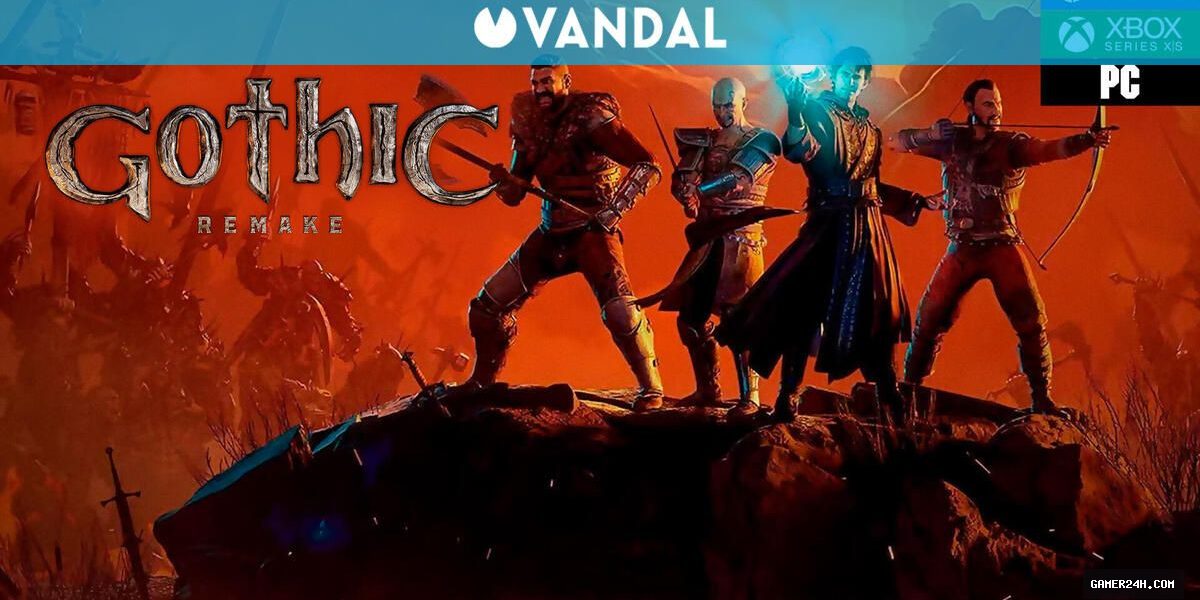
Gothic 1 Remake is finally opening its gates, inviting players to step into the grim corridors of the Mining Valley Penal Colony from the very first moment of the adventure. The game starts you as a nobody, barely taken seriously, and rewards patience and sweat as you rise to become a hero revered by society. Achieving such a transformation is no small feat; the nameless protagonist must prove he is more than an ordinary man, proving himself through simple quests before confronting colossal challenges that will forge his legend.
The developers’ decision to strip away guides, GPS, and other aids forces players to build the hero’s legacy from scratch, echoing the uncompromising spirit of the original release. Gothic was among the first Western RPGs to lay the groundwork for future titles, and its influence can be seen in contemporary giants like The Witcher, which inherited its open‑world depth and socially conscious storytelling.
Originally crafted by the now‑defunct Piranha Bytes studio in Essen, Germany, Gothic aimed to deliver a gaming experience unlike anything else in the industry at the time. Its unique mechanics quickly attracted a dedicated fanbase, cementing the game’s status as a cult classic.
Today’s players encounter a world that feels both oppressive and atmospheric, a stark contrast to the polished, high‑definition experiences that define the current market. The original title and its recent optimized re‑edition, known as Gothic Classic, have inspired studios such as CD Projekt to elevate the concept to new heights of quality. The franchise’s legacy lives on in The Witcher series, which blends open‑world exploration with a narrative that balances social critique and medieval fantasy, providing depth and meaning to every action.
The design of characters and monsters has benefited greatly from this qualitative leap. The game’s bleak, dark tone is built on ochre and gray hues that convey a sense of decay and oppression. Fans of grimdark literature—think Joe Abercrombie’s The First Law or George R. R. Martin’s A Game of Thrones—will recognize the parallels between modern fantasy and the vision first presented by the German studio over twenty years ago. These identity markers, once rare, have become a staple in games where setting is crucial to immersing players in harsh, unforgiving worlds where hard work and perseverance are essential to survival and growth.
Barcelona‑based Alkimia Interactive, a studio staffed by veterans of the Gothic franchise, has laid the groundwork for a remake that starts from a single, unmistakable goal: to honour the original’s spirit while polishing its visuals and, where feasible, updating the gameplay for contemporary audiences. Unlike many modern remakes that simply repackage old content, this project stays true to the source material, eschewing the familiar tutorial aids that newer titles often rely on.
The NPCs now behave with a level of realism that immediately sets this remake apart, a feature that stands out as one of its most significant strengths. This natural interaction shapes the entire gameplay experience, as players navigate a world where every character reacts authentically to their actions.
Gameplay remains rooted in classic RPG mechanics: you control a lone protagonist, a prisoner thrust into a harsh, hierarchical environment where humiliation and power dynamics drive the story. The setting is a penal colony built to harvest minerals for the empire’s war against its arch‑enemies, the orcs.
The narrative remains faithful to Gothic Classic, but the remake introduces fresh twists in side missions and dialogue nuances. The plot centers around three rival factions and explores economic and religious themes. The Swamp Camp believes awakening the Sleeper will free them, the New Camp rebels focus on destroying the barrier through brute force, while the Old Camp adheres to a law‑driven society where corruption and conspiracy dominate.
Even the smallest foe can lead us straight to the grave. To climb the social ladder in this unforgiving world, we must carefully choose the faction that best serves our survival. Yet uncovering that choice requires delving into each group, meeting their leaders, and immersing ourselves in their philosophies. In doing so, we discover the most compelling element of the adventure: a profound examination of humanity when confronted with the harsh realities presented here.
There is no single path to survival, but there are inevitable facets we cannot escape—being reduced to a mere tool to achieve certain objectives. Even if those goals do not align with our own, sometimes we have no choice but to play along. This dynamic gives rise to a delicate affinity system, a fascinating sociological study that unfolds beneath the guise of a fantastical narrative, mirroring many parallels with our contemporary world.
Just as we relish a storyline that follows the classic game’s trajectory with subtle tweaks, the gameplay offers an uncommon style for today’s market. Survival is the core objective. We begin in a brutally hostile realm that despises us, where every mistake is harshly punished. In the early stages, even the simplest enemy can lead us down a path of bitterness, making it crucial to master social progression rather than the traditional level‑up experience system. This is not mere whimsy; the initial battles are savage and unforgiving. The protagonist’s movement feels clunky and heavy, leaving us vulnerable in the first exchanges. The sense that we must improve immediately to survive is a concept inherited from the original title.
The feeling of advancing and carving a path through this world is as demanding as it is rewarding. While the essence is respected, its rudimentary nature often frustrates players who lose patience quickly. Alkimia Interactive’s decision to preserve Gothic’s hallmark traits reflects a clear desire to keep the series’ core identity intact—an approach with both positives and negatives. On paper, the idea works wonders, but in practice it immerses us in a desperate gameplay style that could benefit from some refinement. Maintaining the classic spirit while preserving its flaws is a costly legacy that still echoes from twenty years ago. The lighting offers softer tones, which may alienate purists. The grittiness of combat is not inherently irritating—players will judge it based on personal taste—but it affects the game’s pacing. The slow progression, coupled with the need to endure unnecessary hardship and adapt to a very specific playstyle, can be frustrating. The absence of navigational aids—no compass, markers, or fast‑travel—forces us to fully immerse ourselves, memorize the map, and track NPC locations. Advancing through factions unlocks better gear, new areas, missions, and, most importantly, new masters. Leveling up comes at a steep cost: you must know a master, have the money, and possess the required learning points. The faction you belong to largely determines how you tackle the game. To wield magic, for instance, you must join a specific group, find runes and scrolls, and locate the right masters. Ultimately, magic is as effective as it is expensive, a truth only revealed after navigating the complex acquisition process.
All of this will feel familiar to hardcore fans of the franchise, as the developer has chosen to follow this path in the adaptation. However, this does not mean there are no fresh elements in certain areas. For example, combat—while retaining the original’s rawness—features new animations, a slightly more aggressive AI, and a noticeably improved physics system that feels more consistent. A similar upgrade occurs in the progression system, now explained more clearly with less erratic costs than in the original Gothic, though still quite demanding. This aligns with the exploration phases: the world we uncover is more dynamic and versatile, with expanded zones, more secondary characters, and additional depth.
Gothic 1 Remake breathes new life into the classic with a roster of unforgettable characters and fresh dialogue that enriches the narrative tapestry. The inventory system has been streamlined, offering a smoother, more intuitive experience, while the save mechanics now grant players greater flexibility. Subtle tutorials guide newcomers through the plot, preventing them from losing track of key events. The lore has been expanded, shedding light on the mystical barrier and the war with the orcs, making the story more coherent and easier to follow. Even seasoned players will discover new animated scenes and cinematic sequences that justify revisiting the tale, provided they are willing to navigate the minor hiccups highlighted earlier.
Underpinning all these improvements is a complete technical overhaul powered by Unreal Engine 5. Alkimia Interactive has embraced the engine’s dual nature—offering stunning visual fidelity while grappling with performance trade‑offs. The world now glows with a richer, more realistic lighting palette that breathes life into every environment. However, the softened illumination has, for some, diluted the oppressive atmosphere that defined the original, a subjective shift that may reflect the generational leap rather than a flaw in world design.
Ultimately, Gothic 1 Remake remains a faithful recreation of the original’s gameplay, offering a minimal yet acceptable graphical upgrade for today’s standards. While the homage to the classic is commendable, the title still carries its inherent strengths and weaknesses. The steep difficulty curve and limited combat refinements echo the original’s challenges, and Unreal Engine 5’s recurring performance instability continues to pose a hurdle for players seeking a seamless experience.
❓ Frequently Asked Questions (FAQ)
What makes Gothic Remake: Barcelona a challenging experience for new players?
The remake removes modern conveniences like guides and GPS, forcing players to explore the Mining Valley Penal Colony on their own. This map‑free, hardcore approach demands patience, careful navigation, and a willingness to learn from mistakes, mirroring the original game's tough learning curve.
Will the Gothic Remake retain the original game's story and setting?
Yes, the remake starts players as the nameless protagonist in the same grim corridors of the Mining Valley Penal Colony. It preserves the original narrative arc—rising from a nobody to a revered hero—while updating graphics and mechanics to meet modern expectations.
How does Gothic Remake: Barcelona influence the broader RPG genre?
By reintroducing hardcore, map‑free gameplay while polishing visuals and controls, the remake bridges nostalgic fans and new players. It sets a benchmark for future remasters and highlights Gothic's foundational role in shaping modern RPGs like The Witcher, showcasing its lasting impact on open‑world depth and socially conscious storytelling.
News Source: Elespanol





Comments
Be the first to comment.