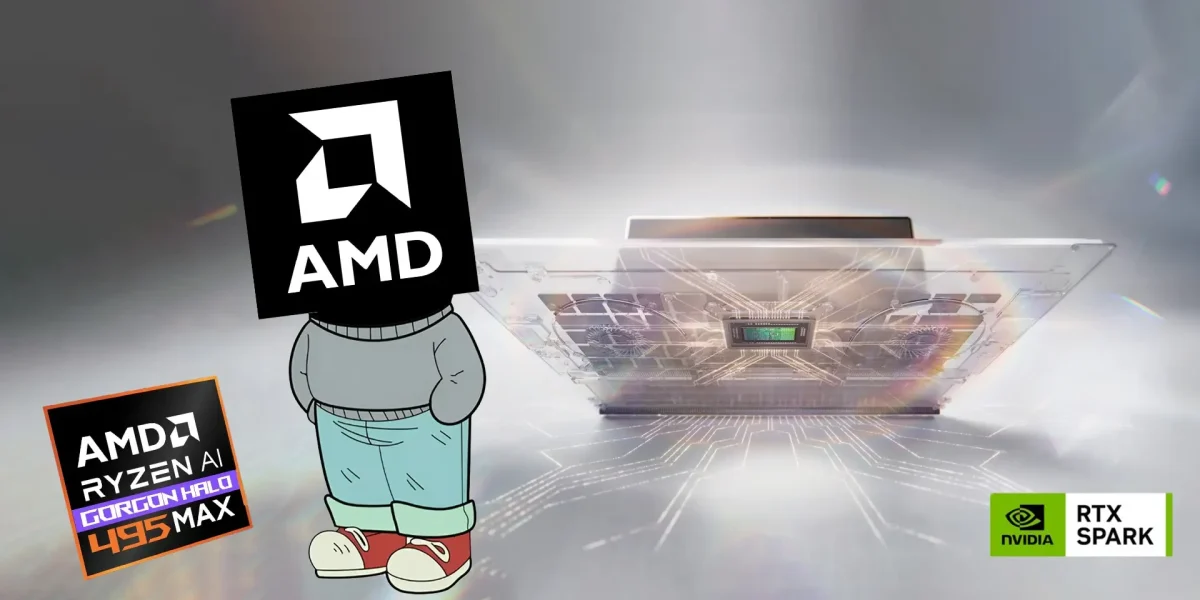
AMD executives responded with great confidence to NVIDIA’s recent announcement of the RTX Spark line, assuring that their current Strix Halo processors and the future Gorgon Halo generation will provide a significantly superior platform for developers. Although NVIDIA unveiled these new consumer-oriented equipment during Computex 2026, AMD welcomed this competitive scenario, arguing that its technology will continue to dominate the market due to the impressive amount of memory its processors possess.
Rahul Tikoo, Vice President and General Manager of AMD, expressed profound enthusiasm for the arrival of this strong competitor in the local AI market, highlighting that his company had dominated this critical sector alone for nearly two years. He explained that having these two major companies competing in the same space will demonstrate that this new technology is truly beneficial for daily users and will help create better tools for computers running Windows.
Comparing directly the specifications revealed by NVIDIA, AMD leaders emphasized that their current portable computers already offer astonishing capabilities that easily overshadow the features announced by these new rivals. While Nvidia’s equipment will reach a maximum of 128 GBs of local memory along with a 20-core processor, AMD defends its prestigious position with a powerful architecture of 16 cores and 32 threads.
In this text, the paragraph with the strongest news value is the one that discusses the comparison between the specifications of NVIDIA’s new equipment and AMD’s current and future processors. This comparison highlights the competitive edge that AMD believes it holds due to its impressive memory capabilities. The analysis block explains the potential industry impact of this competition, suggesting that it could lead to significant advancements in AI technology.
Software chief Andrej Zdravkovic made a forceful statement to industry journalists, insisting that any serious professional would be making a grave mistake by not selecting a Strix Halo system for their demanding daily workloads. He went on to downplay the alleged edge of NVIDIA’s closed ecosystem, asserting that its own programming platform is highly intuitive and offers creators a completely seamless transition.
When asked about the supposed advantage of CUDA in choosing a machine, the executive replied, “If you had asked me the same question three years ago, I would have said yes, it mattered a lot. I think it matters less now.” He added, “NVIDIA has built a phenomenal ecosystem around CUDA, and our advantage is that ROCm is, from a developer’s perspective, extremely user‑friendly… switching from one to the other is straightforward, and the only issue arises if your application ends up using some of NVIDIA’s proprietary commands that we don’t support, and vice versa.” He concluded, “At this point, not buying a Strix Halo laptop is a mistake.”
The heated corporate showdown will reach its peak in the third quarter when AMD officially launches the new Gorgon Halo processors. These will serve as a direct upgrade to the current lineup, retaining Zen 5 cores and the existing graphics architecture while boosting unified memory to a staggering 192 GB. Although this massive technical capacity gives the company a clear competitive edge in handling complex artificial‑intelligence workloads, it is crucial to remember that the ultimate performance of these high‑end platforms will depend on a multitude of additional factors beyond a single specification.
News Source: Tarreo





Comments
Be the first to comment.