Game Overview & History
I USED TO LOVE Blitz on the VIC-20. My dad and I spent hours taking turns trying to flatten that cityscape andland the aeroplane.
The sheer joy we experienced when I eventually cleared the way to safely bring the aeroplane down to earth,to see the anonymous pilot emerge and wave in appreciation (or relief) of our persistence. Ah, how easily pleased we were back in those simpler times…
Gameplay Mechanics & Systems
Back in the 20th century when I was obsessed with using a single button to play, Blitz was an obvious naturalfit for experimentation, so I ran with it, adding a few new features to see what happened.
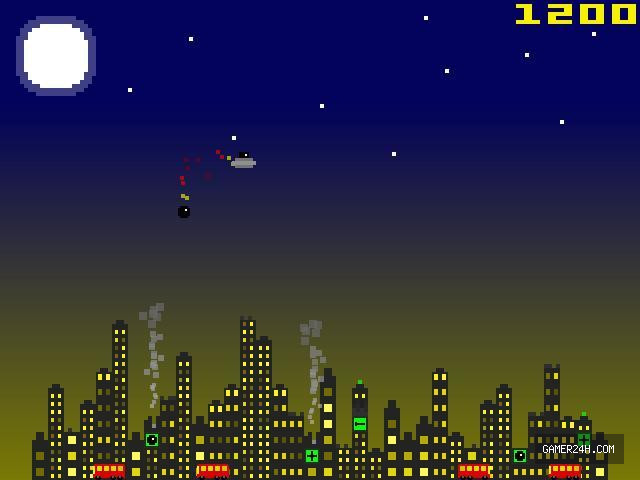
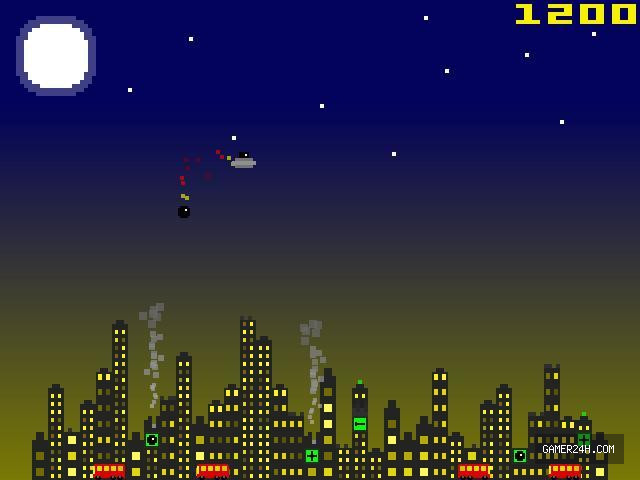
In Bombi, a damaged flying saucer’s slowly drifting to Earth and in need of a landing strip.
Release & Industry Impact
But, hold on, there’s a city in the way.
Perhaps unloading this cargo of bombs will keep the saucer in the air for longer…
Press the space bar or the left-hand mouse button to drop a bomb (make sure the mouse pointer’sover the game).Press Esc to quit the game.You start with only a single bomb, but with careful aiming you can change that…
Hit the bomb in a building to get an extra bomb.Hit the + in a building to get extra blast depth.Hit the – in a building to get a forward-firing missile.Three quick tips:
Watch out for the very solid chunks of building that need four blasts to destroy.Blow up the buses for bonuses.Aim to earn at least one extra bomb as quickly as possible; then go for the bigger bangs (or theforward-firing missile if you need protection).There aren’t many variables to balance in the basic game, but it’s still an effort to create a desirable feel: asense of just being able to complete the objective. I don’t believe I have hit that sweet spot though, mainlybecause I didn’t stick to the superior, tighter VIC-20 proportions for my interpretation.
The proportions of the components and overall scale have quite an effect on play. I realised that when Ireplaced my VIC-20 with a C=64. I innocently expected to experience a superior version only to find it hadn’tbeen scaled up to the larger screen and so felt too remote, too removed from play; that combined with theincreased distance between aeroplane and city also made aiming harder at first. The cityscape was wider,with more buildings to destroy; at least the proportions meant that your breathing space was no worsethan before.
In Blitz the granularity of play is a coarse cell-based resolution. The aeroplane and bomb move throughspace one cell at a time rather over individual pixels. The bomb destroys buildings in chunks. Thiscrudeness makes it easier to figure out if it’s possible to destroy all the buildings in time (ultimately it’s asimple matter of there being only so much space to go around). There are only so many cells available,so if you drop each bomb as quickly as possible and never miss, you should be able to land – andpreferably with a margin for error.
I wanted a smoother experience overall but there are benefits to a cruder granularity, namely it’s easier toappreciate the virtual space. In Bombi, the aeroplane and bomb move through the sky at a pixel resolution.I did the aeroplane constantly descending, but it felt better to change its altitude when it wraps aroundinstead (by a cell).
To minimise the need for great precision, the bombs are always locked to the nearest cell (aligned tobuilding the saucer’s above) rather than falling at the exact pixel you release it. And they destroy onlyone cell of a building at a time, rather than the four or five in Blitz. The reason for this was to to give youroom you to change, to evolve.
Additionally, the relationships between the following variables need to be considered:
The speed at which the aeroplane moves through the air: too fast makes aiming trickier and youget closer to the buildings faster; too slow and it takes forever to get anywhere and the drama isreduced.How quickly or by how much the aeroplane descends: too fast can be too challenging; too longis too dull – not dramatic enough.How quickly the bomb falls (effectively the frequency at which you can release bombs): too slowand you could end up with not enough time to clear the way; too fast and you can be too powerful.The combined height (or area) of the buildings and how the individual building heights (are) are(is) distributed.Adding accessories such as extra bombs to drop, increased destructive power and forward-firingmissiles only complicates matters. They need to worth taking a risk to collect, but if their effects are toopowerful…
The friction necessary for good drama comes from the balance of comfort and discomfort, certainty and uncertainty: too much emphasis in one direction for too long can lead to less dramatic results; a slightteetering on the other hand can enrich the experience. The feeling that the odds are stacked against youbut there is a chance to make the difference – and feel capable of meeting that challenge.
If the aeroplane’s flying and descending too quickly, you have less time to react. If your agency is tooheavily impaired, if you can’t drop bombs quickly enough and their effect isn’t big enough to make up forthe reduction in time, you won’t feel empowered enough to make a difference. •


