

What makes a comic strip great? The daily newspaper format offers only a few panels—sometimes just one—to land a joke, which has made it easy to dismiss as the disposable “funny papers.” Yet strips like Snoopy and Garfield have become woven into the fabric of culture, proving that greatness is possible within so little space. But what, exactly, constitutes that greatness?
The first instinct might be toward something “deep,” citing strips such as Peanuts and Calvin and Hobbes that occasionally stepped outside comedy to say something thoughtful about the world. That path doesn’t suit every strip, though: for Garfield, greatness could come down to a single clever, relatable gag; for Prince Valiant, it might be visual appeal alone.
So how should Gary Larson’s The Far Side be judged? It never dealt in life-affirming depth, and Larson’s characters were often grotesque rather than beautiful—chosen to enhance the comedy. While it’s tempting to link greatness with impact, such as the Stegosaurus strip that earned a new name for a dinosaur bone, Larson’s work never set out to end up in science books.

The argument here is simpler: Larson was trying to make the funniest joke each day. That’s why he didn’t rely on recurring characters—it wasn’t about them so much as the joke itself. Greatness, then, should be measured by the effectiveness and cleverness of that joke, since making readers laugh was the strip’s purpose.
With that lens, here are 10 Far Side comics considered Larson’s best—not because they made headlines or said something profound about life, but because they’re simply really clever and funny.
Find Peter
A highlight of Larson’s work was how much he trusted his audience. Sometimes the punchlines were broad and dumb—in the best way—and sometimes his comics functioned like a comedic scavenger hunt. This is a strong example of a joke that only pays off once you figure out which cubicle to look in.
A deconstructionist masterpiece
Larson didn’t do this often, but occasionally he used The Far Side to break the fourth wall with the reader—using a panel to deconstruct the art of comic strips. This one is about “sketchy”-looking characters, so it features ones drawn especially crudely. It’s genuinely clever, though you have to pay fairly close attention to get it.
And the complete opposite kind of masterpiece
A Far Side didn’t require subtlety to be great. For this one, humor comes from overkill: it’s obvious the man was killed with a bowling pin, and the joke is that these cops remain baffled despite being surrounded by hundreds of them.
A clever twist
The Far Side often found ways to put a brand-new spin on something very old. The Peter Pan example above works well, but this one about Pinocchio may be even funnier—his whole drive is wanting to be a real boy, so what situation would suddenly make him wouldn’t want that?
More deconstruction
This is another example of Larson subverting the medium, if not his own. Alongside daily strips, newspapers often featured activity panels like “spot the differences” and “hidden images.” Here he mocks hidden-image comics by showing a bunch of badly hidden appliances in a forest. The punchline lands best: it claims there are 127 appliances here, which there obviously aren’t.
Find the punchline
This is another strong example of a scavenger hunt for the punchline. Your eye first lands on the giant fly woman, then moves to the woman the artist is painting, and finally reveals what’s reflected in the artist’s glasses.
Reconstruct the punchline
This strip takes the “find the punchline” concept even further. It takes a few seconds before you realize the joke: there was a window washer, right before the woman opened the window.
Snakes
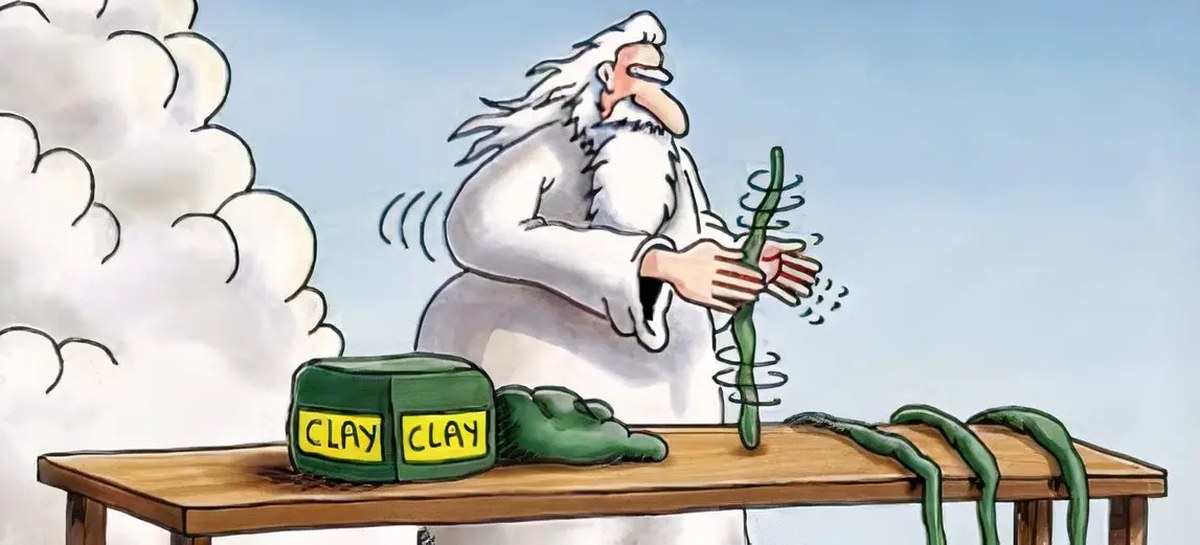
While Larson never really went deep on the meaning of existence, he sometimes tackled the silliness of it all in genuinely funny ways. The idea that God made snakes the same way a kid does with Play-Doh is such a clever concept that it sort of trivializes all of existence.
Love triangle
Like the bowling pin comic, this joke’s cleverness comes from the characters’ lack of cleverness.
Smoking dinosaurs
This is a really famous Far Side—but not because it changed dinosaur history. It’s beloved for showing off many wonderful Larson traits in one place: his love of comics with dinosaurs, and his fondness for dark, morbid jokes. On its surface, the image of dinosaurs smoking cigarettes is hilariously lowbrow, yet the idea that they went extinct from smoking is incredibly clever. That’s why this stands as Larson’s best-ever Far Side—a whole lot of Larson packed into one little rectangle.























1 comment