

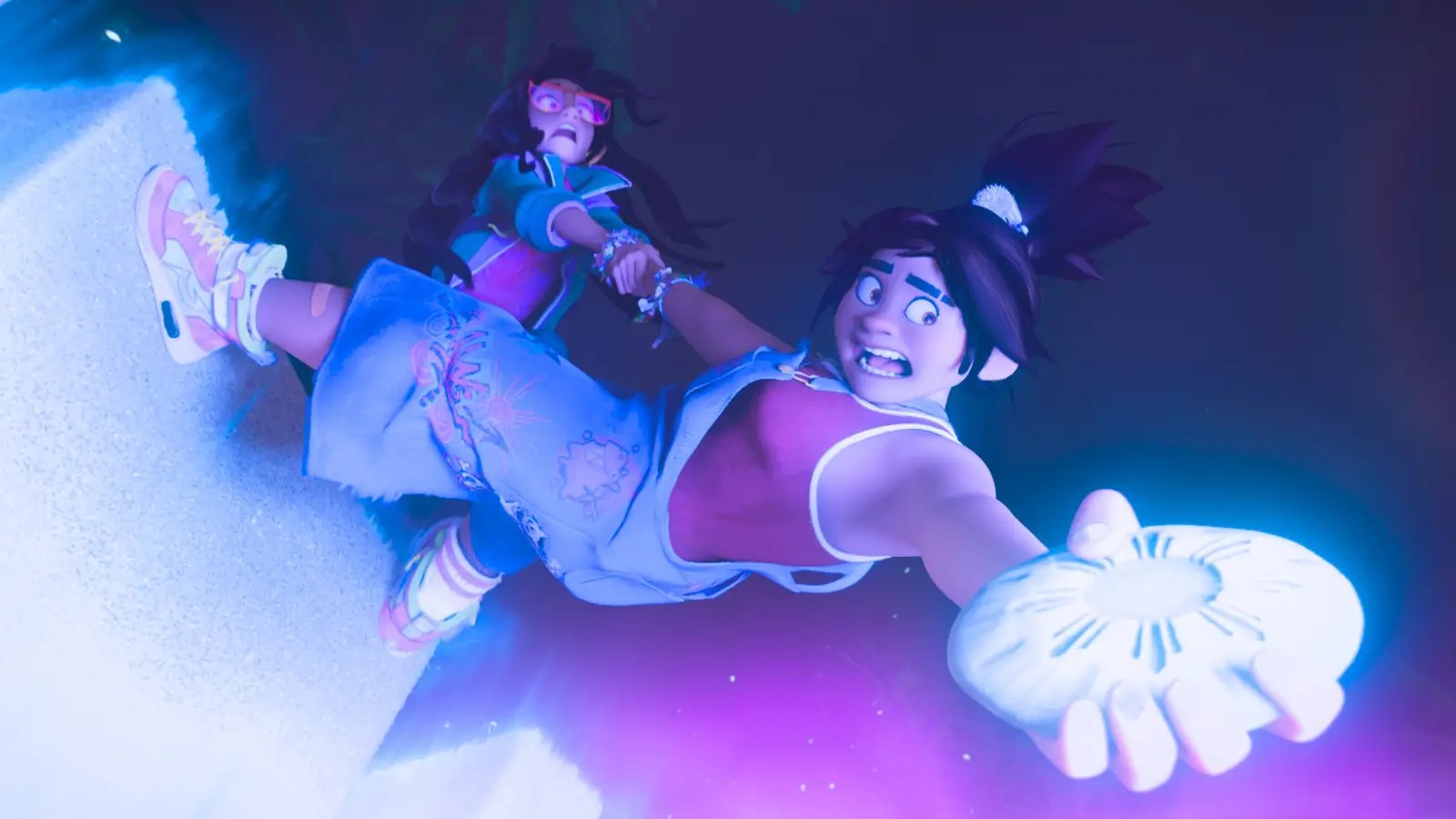
In DreamWorks’ newly released animated film Forgotten Island, teenage leads Jo and Raissa repeatedly exchange a single Tagalog phrase—”Tayo na!”—that quietly carries the emotional weight of their friendship, though the movie never spells out its meaning. Writer-directors Joel Crawford and Januel P. Mercado deliberately leave the expression unexplained, trusting audiences to infer its significance from context, much like other Filipino cultural details woven throughout the film.
The phrase proves trickier than it first appears because its meaning shifts depending on how it’s spoken. As Filipinos and Tagalog speakers have been explaining online, “Tayo na!” can colloquially mean “Let’s go!”, “You and me!”, or “Get up!” depending on pronunciation, who is speaking, and whether the moment carries romantic, parental, or platonic weight.
A Catchphrase That Grows in Meaning
The film deploys the expression across a range of situations as Jo and Raissa confront hidden tensions and big changes in their relationship. Either urging each other into adventure or revving one another up in the face of danger, the girls repeat “Tayo na!” throughout. The first time Jo says it—upon meeting Raissa for what turns out to be nearly the last time before her departure—she pairs it with English: “Let’s go! Tayo na!” It sounds casual at first, but over the course of the film the catchphrase accumulates new weight and deeper significance.
Their voice actors, Liza Soberano (Raissa) and singer-songwriter H.E.R. (Jo), say their own Filipino roots shaped how they interpreted the phrase scene by scene, allowing them to land its shifting nuances with authenticity.
“We grew up saying that. I think about my mom [saying it while] rushing me in the morning to get to school. But for us, it became like, our phrase. To say like, ‘Hey, come on, you. You’ve gotta join me. Let’s go.’
H.E.R., voice of Jo
“I grew up hearing my grandma say it a lot. It’s actually a very formal way of saying ‘Let’s go.’ ‘Tayo na,’ more than anything, means ‘I’m not doing this without you.’
Liza Soberano, voice of Raissa
Anchored in an Impending Departure
The phrase gains its power from the story’s central conflict. Jo and Raissa are about to be parted as Raissa leaves the country for college, leaving Jo feeling hurt, rejected, and frightened by a future without her best friend. When a portal opens to the magical island of Nakali—a place the two girls have sought their entire childhoods, spurred on by stories from Jo’s grandmother—Raissa balks at stepping into the unknown. But Jo has their catchphrase ready.

Throughout the film, both girls use “Tayo na!” to compel each other toward steps they might otherwise refuse, transforming it into a private code. The effect mirrors how “Oklahoma” functions in Ted Lasso or “Grapefruit” appears in horror cinema, where characters deploy agreed-upon words to demand truth over comforting lies. Here the phrase demands action and commitment instead.
“Once I say ‘tayo na,’ she knows I’m serious. You can’t back down from a ‘tayo na.’ It’s almost like an initiation. Like ‘If I say tayo na, you can’t say no.’ It’s our promise with each other.”
H.E.R., voice of Jo
“We both kind of treat it that way. It’s our safe word that we have for each other. You know it’s serious, you know it’s game time when we say this. You don’t have a choice. It’s like the best-friend card.”
Liza Soberano, voice of Raissa
A Safe Space on Set
Both actors credit their Filipino heritage with helping them navigate the subtleties of the lines and their characters’ relationship. It also gave them room to contribute to the script in small ways. H.E.R. is particularly proud of a jokey diss where Jo mocks a longstanding bully by calling his beloved car a “cheapney,” a nod to the Filipino jeepney that’s all over Manila.
“It was so much fun,” she says. “I just loved how much we were able to be so ourselves. Even though we might have been nervous at times, or shy, or whatever, it just was so organic, especially because we’re both Filipino. We’ve been talking so much about how when you meet another Filipino, immediately you’re like family. […] You relate to each other, and it’s like a safe space. We experienced that recording together.”
Looking Ahead
Forgotten Island is now in theaters, inviting audiences to catch the many layers of “Tayo na!” on their own—whether they already know its meaning or are discovering it for the first time alongside Jo and Raissa.























1 comment