

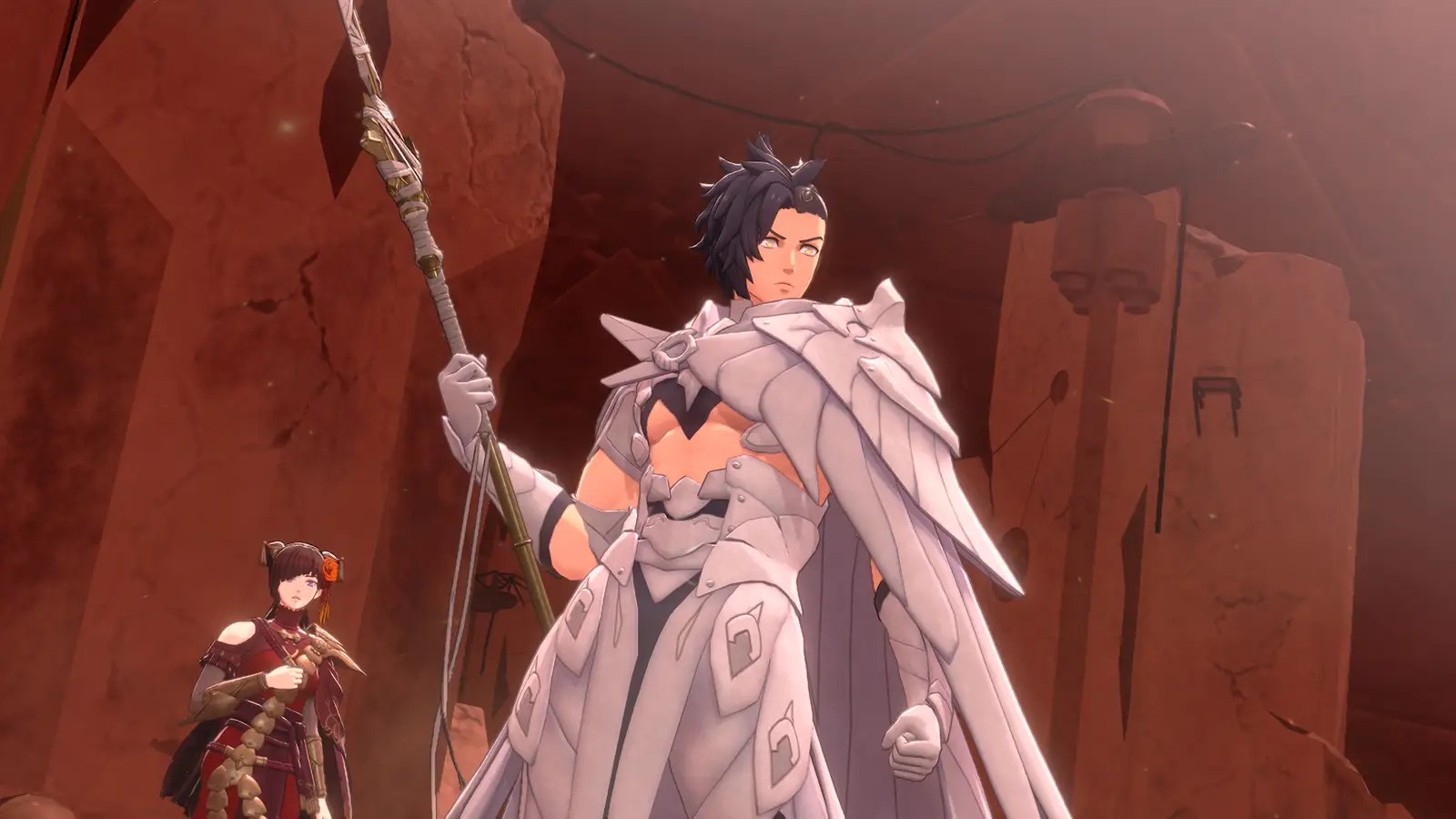
Months after Fire Emblem: Fortune’s Weave launched, players have assembled what may be the most convincing explanation yet for one of the game’s central mysteries. According to a theory circulating across Reddit and GameFAQs, the silent protagonist Eshmel—the Herald of the Pale Raven who leads Dagda’s ruined people against Balor and the underworld—was once Solel, one of the Flame Lords whose failures shaped the world players now explore.
The comparison arrives naturally for anyone familiar with Nintendo’s storytelling traditions. Like Byleth in Three Houses, Eshmel speaks little, is inhabited by another person’s soul, and serves as the linchpin figure of an empire despite appearing to lack a personality of their own. The game never confirms who Eshmel used to be outright, leaving fans to piece together clues from across its branching routes.
A Soul Plucked From the Aether
The theory gains weight when examined against Fortune’s Weave’s opening premise. As the title character begins their journey, players literally construct Eshmel, with Fortuna and Kunlun village’s leader using ancient space technology to create a Mediator—a theoretically perfect being designed to shepherd the villagers. Whether Mediator souls originate anywhere specific remains unclear, but for Eshmel specifically, Fortuna selects one from the aether, declaring it fitting for that soul to make amends and restore light to Dagda.
Those words carry little meaning at first, yet they echo throughout the narrative as players alter the Flame Lords’ fate and encounter countless individuals who clearly need redemption. The game’s ending never directly reveals Eshmel’s former identity, but the thematic scaffolding points toward a specific answer.
The Visual Evidence
For those who played Cai’s route or completed Anna’s paralogue, several similarities may have already surfaced. In Anna’s paralogue, players fight alongside her as an elephant rider while being joined by Solel, whose Trident class appears unique to his family among Dagda’s gods. The only other divine figure in the pantheon wielding a Trident is Aurora, Solel’s daughter—while Eshmel stands as the only being who begins life as a Trident.
Observing Solel in battle reveals additional parallels. His combat stance mirrors Eshmel’s almost identically, though this alone represents weaker evidence since Fortune’s Weave borrows animations across most classes. Notably, however, Solel’s stances differ completely from Aurora’s despite sharing his divine class.

A more compelling piece of physical evidence involves the spear itself. When players remove the bandages wrapping Eshmel’s weapon and clean it up, it becomes identical to Solel’s spear. During Part 3, Credna can strip away those bandages, prompting him to remark on how familiar the spear appears.
The game never directly tells you who Eshmel is or used to be. But there’s a convincing theory circulating around Reddit and GameFAQs about who Eshmel was in their previous life, and if you played Cai’s route or completed Anna’s paralogue, you might’ve noticed some of these similarities yourself.
A Polygon writer analyzing the theory
The Lore Behind the Rebirth
Beyond visual clues, the game’s own mythology supports the connection. Fortuna explains that Nabatean souls—children of Sothis and their descendants, recognizable by their green hair—do not return to the cycle of death and rebirth. Instead they are drawn back to Sothis, who, as Three Houses demonstrated, excels at placing ancient souls in unexpected vessels.
This raises the question of what Solel must redeem himself for. Every Flame Lord’s story reads as an account of Solel’s various failures: his stumbles with family in Cai’s route, his nation in Dietrich’s, his ethics in Theodora’s, and his rule as a just leader in Leda’s. One writer noted that the (not)man neglected to act when his father murdered 100,000 people, only responding after his wife came under fire, refused to disrupt the status quo, and allowed the Order of Mithras to run unchecked despite its shady origins and role in Dagda’s decline.
If Solel is indeed Eshmel reborn, Anna’s paralogue suddenly makes greater sense. The sequence ends with Solel finally recognizing that the Order of Mithras cannot be trusted while realizing their influence runs deeper than he could have imagined. With doom approaching and nothing left to stop it due to his neglect, the ending transforms from a curious side quest into a poignant moment of failed redemption.
Looking Ahead
The possibility remains that Nintendo will eventually confirm or deny the theory through an expansion—perhaps one granting Anatolia’s route as fans have long requested. Whether players want these lingering mysteries resolved or preserved in ambiguity is itself worth debating, but until official word arrives, many remain convinced that Eshmel and Solel are the same soul.
For now, the community continues to celebrate Fortune’s Weave for embedding such a layered narrative reward, proving that even its silent protagonist hides a story rich enough to sustain passionate analysis long after the credits roll.























Join the conversation