

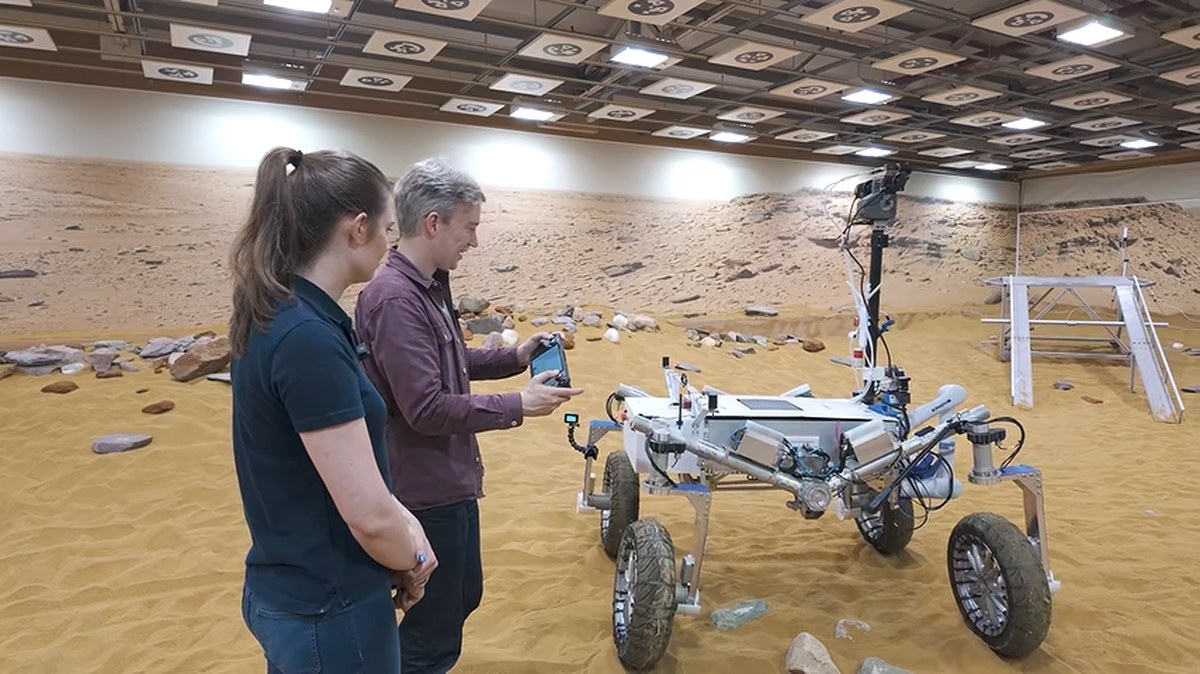
When aerospace engineers at Airbus needed an intuitive physical interface for remotely piloting a robot destined for Mars, they didn’t build a bespoke control rig — they reached for a Valve Steam Deck. During a recent demonstration at the company’s Stevenage campus in the UK, the aerospace giant revealed that its ExoMars rover prototype is being driven forward using a modified handheld gaming PC, with a simple “bumper” press rotating the wheels 90 degrees to sidestep the awkward turning circle that would otherwise risk jamming the machine on a stray space rock. The short documentary footage captured the rover navigating the terrain of Airbus’s test bed, offering a rare glimpse of how the hardware that powers millions of living-room gaming sessions could one day help shape the surface of the Red Planet.
The device appears to be a standard-issue Steam Deck, whether the LCD or OLED variant, running what looks like custom software tailored to the rover’s navigation needs. While the footage shows a human operator taking the controls, Airbus is clear that this is a stepping stone rather than a final solution. The company is simultaneously developing autonomous navigation systems, meaning the rover will not rely on a remote pilot when it eventually makes its way to Mars.
A Gaming Handheld on the Road to Mars
The ExoMars rover, officially named the Rosalind Franklin, is part of a long-term ambition for Airbus Defence and Space UK to deliver a working rover to the Martian surface by 2030. The project is a significant undertaking, with the engineering team working across multiple disciplines to ensure the vehicle can survive and operate in one of the harshest environments in the solar system.
“The team at the aerospace company’s Stevenage campus in the UK are developing autonomous navigation for the ExoMars rover, using what appears to be custom software running from a Steam Deck to navigate the terrain of their test bed. When the rover finally touches down on the Red Planet, it won’t need to be steered via Valve’s handheld.”
Beyond the navigation systems, Airbus is also developing the mechanical, thermal and propulsion systems that make up the rover’s landing platform. These subsystems are critical to the mission’s success, as the vehicle must endure extreme cold, radiation and the immense stresses of atmospheric entry before it can begin its scientific work on the Martian landscape.
The project is described as ambitious, with Airbus Defence and Space UK managing director Kata Escott highlighting the scale of the undertaking and the company’s commitment to pushing the boundaries of space exploration.
Kata Escott, Airbus Defence and Space UK Managing Director
While the use of a gaming handheld in a serious aerospace application may raise eyebrows, the underlying logic is sound. Steam Decks are engineered around responsive, ergonomic controls and a compact form factor — qualities that translate well to the task of manipulating a rover’s movement in real time. The intuitive thumbstick and bumper layout means an operator can convey directional intent with minimal training, a valuable trait during the early phases of a mission when human-in-the-loop control is still being refined.
From Living Room to Landing Pad
For the gaming community, the footage is a delightful reminder that Valve’s handheld has quietly become more than a portable gaming device — it is a piece of hardware trusted with real-world engineering challenges. The fact that a machine designed for playing games could serve as a prototype control interface for a Mars-bound rover is a fitting tribute to the creativity and ingenuity that define both industries.
Still, the ultimate goal remains firmly rooted in autonomy. When the Rosalind Franklin rover finally touches down on Mars, it will be navigating the alien terrain on its own, guided by onboard systems rather than a human gripping a Steam Deck on Earth. The handheld, in this sense, is a tool for development and demonstration — a bridge between the controlled environment of Airbus’s test bed and the unforgiving reality of the Martian surface.
As Airbus continues to advance its autonomous navigation and landing technologies, the ExoMars project stands as a compelling example of how ideas from one field can illuminate another. Whether it is a scientist designing a control interface or a gamer gripping a handheld controller, the pursuit of intuitive, responsive interfaces is a shared challenge across both worlds — and the journey to Mars may well be powered by the same spirit of innovation.
Looking Ahead
The 2030 target date for the Rosalind Franklin rover sets a clear deadline for Airbus’s engineering efforts, with autonomous navigation, landing platform systems and thermal management all requiring further development before the mission can proceed. As the company refines these technologies, the ExoMars rover will move closer to its ultimate destination — a place where the only steering wheel it will ever need is the one built into its own chassis.
For now, the footage of a Steam Deck guiding a Mars rover across a test bed serves as both a technical demonstration and a playful nod to the unexpected places gaming hardware can end up. As Airbus pushes forward with its ambitious plans, one thing is certain: the road to Mars is being paved with more than just rockets.



1 comment
[…] Article: Airbus Steers ExoMars Rover With a Modified Steam Deck → Kaynak: IGN […]