DreamWorks’ ‘Forgotten Island’ Flips a Classic Friendship Trope Into a Near-Perfect Fantasy Adventure
September 23, 2026 · Gamer24H Editorial Team
DreamWorks Animation has set its sights on redefining the coming-of-age film with Forgotten Island, a fantasy adventure that flips a familiar high-school graduation story on its head and releases in theaters on September 25. Writer-directors Joel Crawford and Januel P. Mercado have layered Filipino folklore, a chronologically tangled narrative, and rapid-fire visual and verbal humor over a tale of two childhood best friends whose friendship is tested as they face the transition into adulthood. The film stars singer-songwriter H.E.R. as Jo and actress Liza Soberano as Raissa, and follows the pair as a magical portal on their final night together pulls them to the legendary island of Nakali — an adventure they can’t fully remember once they wake up there.
At its core, the story is a well-worn one: two best friends who grew up together confront a stressful crossroads as graduation approaches, celebrate their shared past, and reaffirm their bond. The broad shape of that narrative has appeared in popular films like The Perks of Being a Wallflower, Booksmart, and Superbad, and none of the big-picture plot will surprise anyone past their tween years. But the way this story is told is an endless surprise, as Crawford and Mercado complicate the familiar beats with a chronologically tangled structure, unmissable anime references, and a barrage of pop-music needle drops that keep the film perpetually in motion.
A Friendship Built on Shared Memories
The central characters are Filipino teenagers Jo and Raissa, best friends since grade school. Their relationship plays out through a series of illustrative scenes that show all the ways the two girls fill in blanks for each other throughout their shared childhood. Imaginative, morbidly weird kid Jo emboldens nerdy, shy Raissa, while Raissa’s enthusiasm for Jo’s wild creative impulses validates her in ways her peers never have before. Both girls are potential outcasts whose friendship means they never have to be alone, and they grow up together in a mutually fulfilling world of wild little adventures — each commemorated by a trinket on the identical charm bracelets they build with each other.
One of the film’s more daring adult flourishes is easy to miss. Raissa’s family is affluent, living in a vast Manila estate, while Jo shares an apartment with her grandmother Fatima, played by beloved Filipino star Dolly De Leon. Jo helps support the household by working a series of fast-food jobs, while Raissa is free to focus on her studies. Jo takes it for granted that she won’t go to college and Raissa will, assuming they’ll live together as Raissa attends the University of Manila. When she learns that Raissa plans to go to Caltech in the U.S. instead, Jo is shattered — and, on a level she doesn’t want to admit, she is also angry about being abandoned.
It’s genuinely distressing to watch Raissa and Jo build a world together as each other’s support system and lifeline, only to see that friendship unravel. The script puts real stakes into their relationship, and makes it easy to sympathize with both of them as they face the ways they’ve failed each other, and the reasons they still need each other.
Image: DreamWorks
Review of Forgotten Island
When a magical portal opens up on their last night together, inviting the duo to Nakali, Jo sees it as both adventure and escape — a path away from mundanity and from the distance the future is already putting between her and her best friend, a way to postpone their inevitable parting. Raissa is more hesitant, even though the duo has been looking for Nakali since their elementary-school days, when Fatima started telling them stories about the place. But before they know it, they’re waking up on Nakali — and realizing they’ve already had some sort of bizarre adventure they can’t remember at all.
A Mesmerizing Animation Experiment
A large chunk of the film tracks the quest to piece together their forgotten first day on the island. That involves enlisting the help of a were-dog named Raww (Dave Franco), who insists they’re all friends, and following a series of physical clues — from Raissa’s dramatic new side-shave haircut and bat-wings to the tattoo Jo doesn’t remember getting. Other characters they met during the missing time have memories, marks, or objects that slot together to tell the story of the girls’ first day on Nakali, including a catlike cave-dwelling demon named Batiba (Jenny Slate), who exchanges magic for memories.
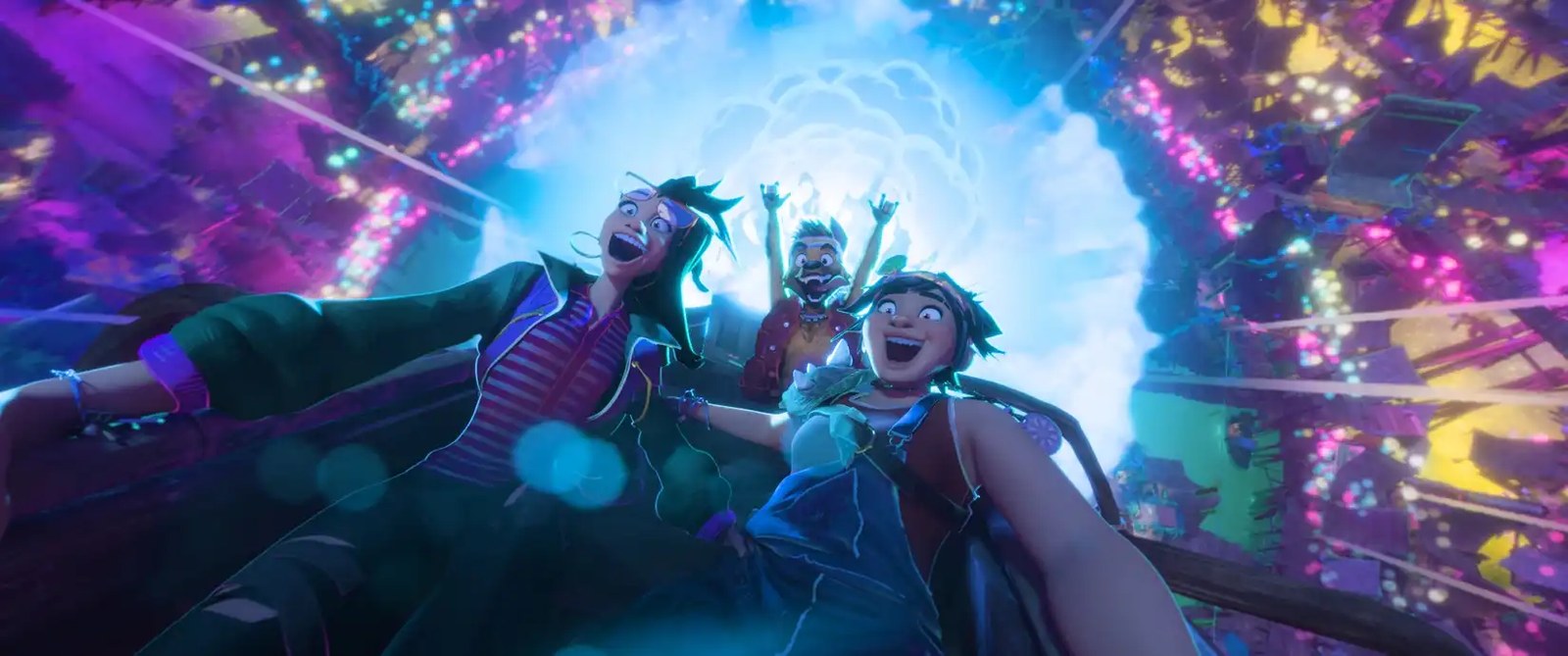
The way these pieces fall together is weird, clever, silly, and extremely colorful, built around surprisingly dynamic, seductive visuals. Just as Crawford and Mercado turned 2022’s The Last Wish — the sequel to a middling spin-off — into a startlingly mesmerizing, ambitious animation experiment, the writer-director duo pushes past the standard look of American CG kids’ movies here. They bridge the gap between Last Wish‘s drama-driven, boldly neon 2D/3D hybrid style and anime-style touches, like flying emotive punctuation and rapid veering between visual styles for emphasis. There’s a lot of action, and it’s kinetic and hyperbolic, reflecting the big emotions at play as Jo and Raissa alternately cooperate and clash.
Quibbles in a Confident Film
Not everything in the movie lands with the same impact. There’s a lot of hit-or-miss comedic business, mostly stemming from support characters like the vain, posturing kataw Prince Mermahn (Kevin McCann), who looks like he just stepped off the cover of a particularly indulgent supernatural romance novel, or Bungi the tiyanak (The Acolyte’s Manny Jacinto), a giant blue baby-demon with three eyes and a mommy complex. At times, it feels like these critters, among the many other creatures populating the film, are present more as an illustrative checklist of Filipino cryptids than as actual characters. Even the ferocious Manananggal, the film’s monstrous Big Bad, is largely around for chase scenes and threatening moments, rather than fully integrating with the story.
Similarly, the pop-hit references get pretty overbearing. It’s one thing to build a few key sequences around numbers like INXS’ “Never Tear Us Apart” or Simple Minds’ “Don’t You (Forget About Me),” two songs with obvious thematic links to the story. It’s something else entirely when the soundtrack features so many pop licks that Forgotten Island starts to resemble a jukebox musical — at one point, Raissa’s father, performing karaoke at a party, manages to tag three different pop hits in probably less than three minutes. There’s plenty of original music on the soundtrack, including a radio-ready new H.E.R. pop song, but it’s a little lost under all the pop-chart music hitting in every third scene.
Looking Ahead
These are comparative quibbles in a movie that operates on such confident emotional footing and in such an impressively expressive vein. After seeing Crawford and Mercado put more creativity and texture into Last Wish and 2020’s The Croods: A New Age than either of those sequels probably deserved, it’s exhilarating to see them flex with a memorably original story. Forgotten Island plays with ideas that have been brought to the screen over and over — about how the official transition from childhood to adulthood is scary and melancholy as well as exciting, and how relationships are built on shared memories — but the creators put their own unmistakable stamp on those ideas. It seems uniquely appropriate for a movie built around the importance of memories to be this memorable itself.
Forgotten Island releases in theaters on September 25.





1 comment
[…] Article: DreamWorks’ ‘Forgotten Island’ Flips a Classic Friendship Trope Into a Near-Perfect Fa… Kaynak: Polygon […]