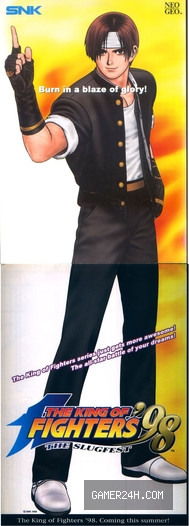
The King of Fighters ’98 (KOF ’98), subtitled Dream Match Never Ends in Japan or The Slugfest elsewhere, is a 1998 fighting game developed and published by SNK for the Neo Geo systems. It is the fifth game in The King of Fighters series and was advertised by SNK as a “special edition” of the series, as it features most of the characters who appeared in the previous games from KOF ’94 to ’97. The game provides no storyline in contrast to the previous games and instead is labelled as a “dream match” like its subtitle, where the player selects a team composed of three characters to participate in The King of Fighters tournament until reaching the boss Rugal Bernstein, even though the character dies in The King of Fighters ’95. Two fighting styles can be selected to fight and several characters have alternate versions to select with their classic moves from previous games.
Following its release, it was ported to the PlayStation in Japan, while an updated Dreamcast port subtitled Dream Match 1999 was released in 1999, featuring remade 3D backgrounds.
The game was well received by critics and fans and is often considered as one of the best The King of Fighters games ever, as well as one of the best fighting games of all time, thanks to its large amount of playable characters and proper balance. Both the original game and the updated version went to sell several copies in Japan. However, despite the game’s sales, the franchise suffered a breakdown due to SNK going bankrupt resulting in the game being the last game developed by designer and director Toyohisa Tanabe who has been working for the series since its first game. A novelization was written by Akihiko Ureshino.
The game was remade as The King of Fighters ’98 Ultimate Match in 2008.
⭐ Review Scores


Gameplay
The gameplay does not differ much from the previous game, KOF ’97. Like in KOF ’97, the player has a choice between two playing styles: Advance and Extra, with a few slight modifications to Advanced mode (unlike in KOF ’97, the character will resume to normal if the player performs a Super Special Move in MAX state). This time when one character loses a round, the losing team is given a handicap in its favor. In Advanced mode, this means that the player‘s stock capacity for Power Gauges is increased by one. In Extra mode, the time it takes to charge one‘s power gauge to maximum level is shortened, and the maximum remaining health requirement for a MAX Super Special Move is increased.
While the game has no story, it still uses the characters Shingo Yabuki from KOF ’97 as unlocakble midboss as well as Omega Rugal from KOF ’95 as final boss.
Characters
All the regular characters from the previous game return, along with several characters from preceding installments such as Vice and Mature (Iori’s teammates from KOF ’96), the American Sports Team (Heavy D!, Lucky Glauber, and Brian Battler) from KOF ’94, and the Old Men Team (or Veteran Fighters Team) composed of Heidern, Takuma Sakazaki, and Saisyu Kusanagi, all characters whose last appearances were in KOF ’95. Rugal Bernstein from KOF ’94 also returns as a Team Edit character, with his alter-ego Omega Rugal (the cyborg version of Rugal from KOF ’95) serving as the game’s final boss in the Single Player Mode. Shingo Yabuki (who originally appeared in KOF ’97) continues as a Team Edit character, but also appears as a mid-boss character during the Arcade Mode. Additionally, the game includes EX versions of certain characters, i.e., alternate versions of characters who use movesets from previous games: Joe Higashi, Ryo Sakazaki, Yuri Sakazaki and Robert Garcia are based on their KOF ’94 movesets, whereas Kyo Kusanagi is based on his KOF ’95 moveset and Terry Bogard, Andy Bogard, Mai Shiranui and Billy Kane are based on their Real Bout Fatal Fury 2: The Newcomers movesets.
Development
In terms of the story, the Orochi Saga of KOF had come to an end, and in response to that, SNK wanted to give the series a “special” nature. Originally, KOF itself was a series that started with the basic concept of something special, but as the series progressed, it gradually began to have its own unique storyline. Therefore, there was no story for 98, but various playable characters returning from previous stories. This is the first time that the KOF series has had a subtitle, and the developers wanted to express that it has a different position from the previous games. All of the members of the development team had to decide who had participated in KOF. SNK definitely released all the characters who had participated in KOF at once, and then repeatedly considered who to bring back. During this process, the developers also took into consideration the opinions of the users especially in the Neo Geo Freak magazine. Rugal is included due to the original creator’s passion over him.
Several characters were given customizations to their movesets. This, helped with the balance of the cast, helped The King of Fighters ’98 become one of the best games in the series. Shinkiro kept being the series’ artist with KOF ’98 remaining as one of his most famous works. The game was ported to several more consoles when compared with previous installments thanks to the new Neo Geo consoles as well as Sony’s and Sega’s. Director Toyohisa Tanabe had negative thoughts about this game due to SNK going bankrupt during the release of this game as SNK would close all of its American operations. While the American Sports Team was not as popular as the other cast members, SNK still paid attention to their detail by producing new sprites and special moves. The big aim was determined to bring back old characters. The same applied to Vice and Mature who were given new moves. Balancing the game took an entire mode. Before publishing the game, Tanabe drew two pictures of Street Fighter characters Ryu and Ken Masters and inserted them into the game’s build. This would predate the release the crossover Capcom vs. SNK which gather both Capcom and SNK characters.
The game’s intro has Iori Yagami destroying the screen with his body which inspired future installments like The King of Fighters 2002 and also coin the catchphrase “Shatter All Expectations” in The King of Fighters XV. There was also a careful approach to drawing the characters during their victory screens when compared previous installments. The victory screens were based on a challenge image used for a bonus fight against Shingo Yabuki. In promoting the game for Sony’s PlayStation, an image of Kyo Kusanagi was made by Shinkiro in a passive state which would change to his eyes open when the game would be ported to the console. In promoting the “Dream Match”, Shinkiro’s illustrations also led to characters in calm state while wearing formal clothes even if it does not fit. However, the Dreamcast port heavily focus on rivalry between Kyo and Iori.
In The King of Fighters ’96, several moves from Kyo Kusanagi were changed in order to adapt him to the new game system. However, the original moveset was still popular among gamers and as such, an alternative version of Kyo was added to The King of Fighters ’97. The introduction of this version was noted to be “a hit” within gamers, the staff kept adding new alternative versions of other characters in KOF ’98. Since this game did not have a storyline, the SNK staff decided to return Rugal Bernstein as the boss character noting that “he’s the only character who truly represents the ultimate KOF boss.” Additionally, some of his special moves were redesigned, which the staff found to have made him the strongest version of Rugal as well as one of their favorites.
Release
KOF ’98 was originally released for arcades on July 23, 1998. It was also released for the Neo Geo AES on September 23, 1998, the Neo-Geo CD on December 23, 1998, and the PlayStation on March 25, 1999.
An emulated version of the game was released as part of The King of Fighters Collection: The Orochi Saga in 2008 for the PlayStation 2, PlayStation Portable and Wii (the game was not included in the Japanese Orochi Hen compilation). The Neo Geo AES version was added via emulation to the Wii Virtual Console in Japan on October 23, 2012, in North America on March 7, 2013 and in the PAL region on May 30, 2013. Another emulated version was released for iOS and Android in 2014. The arcade version was emulated and released as part of the ACA Neo Geo series for the Nintendo Switch on March 3, 2017 with releases for Microsoft Windows, PlayStation 4 and Xbox One following afterwards. On February 26, 2025, it was the first game to be released as part of the ACA Neo Geo 2 series for PlayStation 5 and Xbox Series X and Series S, upgraded with online play and variable refresh rate support.
An updated Dreamcast version was released on June 24, 1999, under the title The King of Fighters: Dream Match 1999, reflecting the year the version was released. It came out in North America on October 16, 1999. It features remade 3D backdrops and runs at 60 frames per second. This version also featured its own anime style intro, produced by the studio Digimation K.K., before it merged to become part of the studio Gonzo a few years later.
Reception
In Japan, Game Machine listed The King of Fighters ’98 on their September 1, 1998 issue as being the most-successful arcade game of the month. According to Famitsu, the AES version sold over 22,651 copies in its first week on the market. During its release week, the Dreamcast version of the game sold 58,354 copies in Japan. As of 2004, the sales increased to 104,049. Famitsu magazine scored the Dreamcast version of KOF ’98 a 30 out of 40. It has therefore also been labeled as a “greatest hits” game.
KOF ’98 is often recognized as the best entry in the series, as well as one of the greatest fighting games of all time. Various reviewers from video game publications have commented on KOF ’98. While reviewing the compilation The King of Fighters: The Orochi Saga, Matt Edwards from Eurogamer noted KOF ’98 to be the most enjoyable game from the collection as well as the most famous game from the series “that really made people stand up and take an interest in the series.” The game also received praise by 1UP.com writer Richard Li who found it to be the most balanced game from the KOF series due to the fact it improved the game mechanics from the previous titles. Jeremy Dunham from IGN gave the game an 8.4, praising, apart from the gameplay and characters, the graphics, the music as well as the background designs added for the Dreamcast version. However, he was disappointed with the lack of story in the game, noting the ones from previous games to be very entertaining. GameSpot‘s Jeff Gerstmann found it to be one of the best 2D fighting games, noting that although new players may find it hard to play due to the difficulty in executing various special moves and how difficult the opponent AI is. Although Andy Chien from Gaming Age found that the Dreamcast port of the game was well done since it does not have the disadvantages that it had in other consoles, he noted it “could have been a lot better.” He also found that the game had a bug when he tried to perform a special move from Mai Shiranui, which unlike the other versions, is very inconsistent. Tom Russo reviewed the Dreamcast version of the game for Next Generation, rating it two stars out of five, and stated that “Not bad, but with so many other high-quality fighters available, this one only makes sense for players nostalgic for old NeoGeo fighting games.”
Legacy
The game was followed by The King of Fighters ’99. Hiroyuki Kono from SNK said that with The King of Fighters ’99 the team was trying to provide new content that previous games lacked. Kono thought that of the Striker idea as a change to the franchise in general. With the Strikes system where the fourth character assisted the playable character, SNK aimed to give the player new ideas for combos. However, it still brought several challengers. The story of the new protagonist K’ in The King of Fighters ’99 set to be the beginning.
However, game developers still wanted Kyo Kusanagi as protagonist and other Orochi arc characters, leading to the development of the spin-off game The King of Fighters EX: Neo Blood where Kyo and fellow newcomer Moe Hibana star as the leads despite using the same game design as The King of Fighters ’99. The Chinese comic The King of Fighters Zillion also follows an alternate narrative involving the Orochi cast but during the NESTS story arc.
Notes
References
External links
- The King of Fighters ’98 at GameFAQs
- The King of Fighters ’98 at Giant Bomb
- The King of Fighters ’98 at Killer List of Videogames
- The King of Fighters ’98 at MobyGames


Gamer24h Editor's Take
The King of Fighters ’98 caught our attention with its unique design and has shaped up to be a must-play masterpiece candidate thanks to the depth of its experience. The visionary approach of developer SNK, combined with the expertise of publisher SNK, has resulted in an exceptionally refined product. Its innovative take on the Fighting genre offers a breath of fresh air for fans of the category. With an overall score of 78, it delivers an enjoyable experience well above average. If you're looking for an absorbing world and satisfying mechanics that pull you right in, this game might be exactly what you've been searching for.