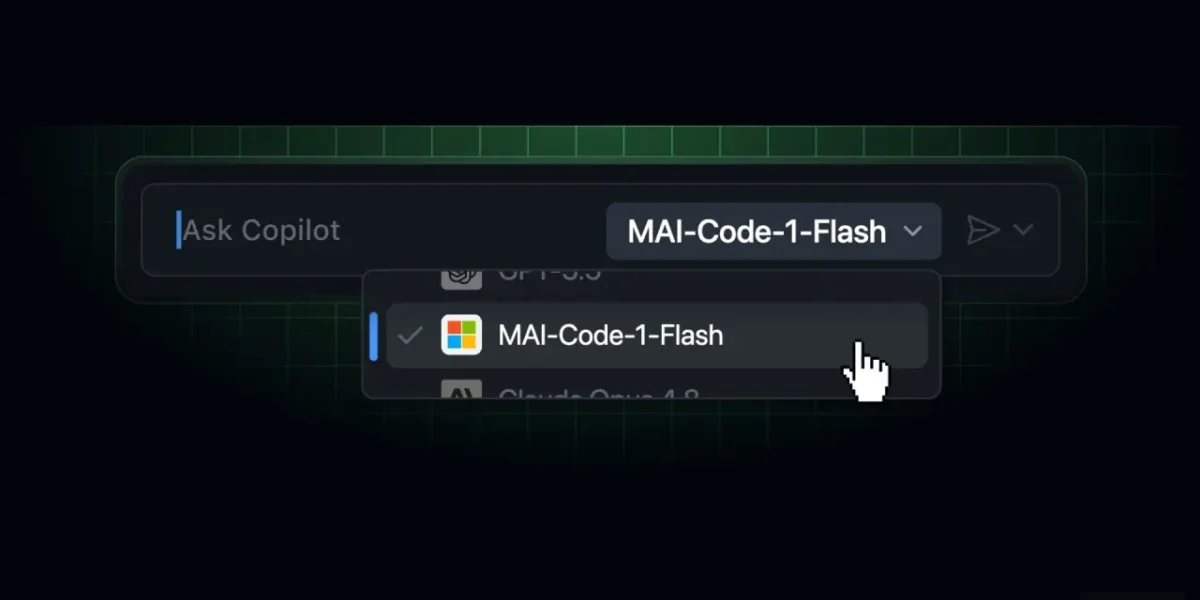
Microsoft has rolled out its MAI‑Code‑1‑Flash model for general availability to GitHub Copilot Business and Enterprise users, giving companies tighter control over policies and billing while finally unlocking Microsoft’s own lightweight, first‑party coding engine.
GitHub notes that administrators of Business and Enterprise plans must activate the MAI‑Code‑1‑Flash policy within Copilot settings before developers can start using the model.
Microsoft positions MAI‑Code‑1‑Flash as a tool for rapid, iterative development rather than heavy architectural or debugging workloads. According to GitHub’s model comparison, it shines in general‑purpose coding and writing, delivering swift, precise code completions and explanations.
The model debuted on June 2 as part of Microsoft’s expanding suite of internally built MAI models. GitHub has since broadened availability to Copilot CLI, the cloud agent, GitHub.com chat, GitHub Mobile, Visual Studio, JetBrains IDEs, Eclipse, and Xcode, though managed Business and Enterprise support remains forthcoming.
Microsoft’s internal benchmark demonstrates that MAI-Code-1-Flash achieves a 51.2% score on SWE‑Bench Pro, outpacing Anthropic’s Claude Haiku 4.5, which sits at 35.2%. In addition, the model consumes up to 60% fewer tokens on the SWE‑Bench Verified suite, underscoring its remarkable efficiency.
Under GitHub’s pay‑per‑use framework, MAI-Code-1-Flash is priced at $0.75 per million input tokens, $0.075 per million cached input tokens, and $4.50 per million output tokens, aligning with the platform’s standard tiered rates.
For organizations, the primary draw of MAI-Code-1-Flash is its operational efficiency rather than raw capability. Its compact architecture delivers rapid responses and curtails superfluous output, making it ideal for high‑volume, repetitive agent tasks—especially in the context of GitHub Copilot’s shift toward usage‑based billing.
The “Flash” model is best suited for quick, focused work and may not handle extensive repositories with deep contextual requirements as effectively. Teams are encouraged to benchmark its output against larger models, particularly when dealing with security‑sensitive code changes or complex, multi‑file projects.
❓ Frequently Asked Questions (FAQ)
What is MAI-Code-1-Flash and who can use it?
MAI-Code-1-Flash is Microsoft’s lightweight, first‑party coding engine that has been released for general availability to GitHub Copilot Business and Enterprise users. It allows companies to use an internally built AI model for rapid, iterative development, giving them tighter control over policies and billing.
How does MAI-Code-1-Flash compare to other models like Anthropic’s Claude Haiku 4.5?
According to Microsoft’s internal benchmark, MAI-Code-1-Flash scored 51.2% on the SWE‑Bench Pro test, outperforming Claude Haiku 4.5. The model excels at general‑purpose coding and writing, providing swift, precise code completions and explanations, making it well suited for everyday coding tasks rather than heavy architectural or debugging workloads.
What steps must administrators take to enable MAI-Code-1-Flash for their teams?
Administrators of GitHub Copilot Business and Enterprise plans must activate the MAI-Code-1-Flash policy within the Copilot settings. Once the policy is enabled, developers in the organization can start using the model across supported platforms such as Copilot CLI, GitHub.com chat, Visual Studio, JetBrains IDEs, Eclipse, Xcode, and GitHub Mobile.
News Source: Neowin



Comments
Be the first to comment.